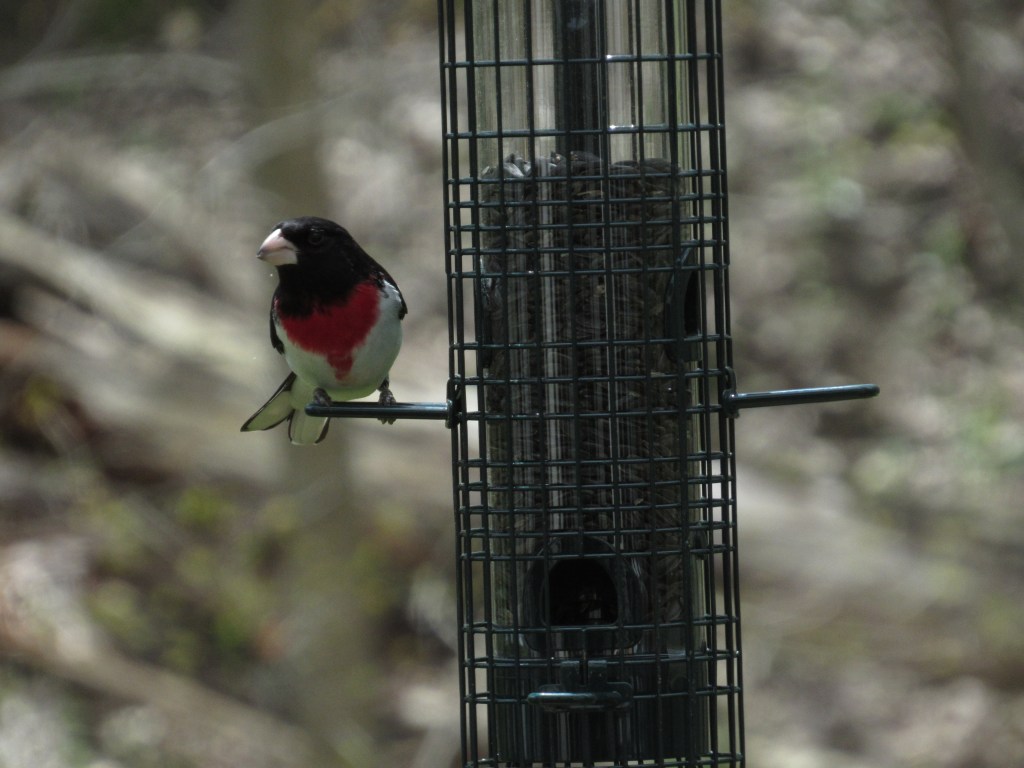


The Rose-breasted Grosbeak (Pheucticus ludovicianus), known for its striking black, white, and red coloring, is a medium-sized songbird native to North America. Both male and female grosbeaks have unique colorations: males exhibit bold black-and-white feathers with a vibrant red patch on their chests, while females are more camouflaged with brown and streaked plumage, which helps with nesting. These birds belong to the cardinal family (Cardinalidae) and are closely related to the Northern Cardinal and Indigo Bunting.
Physical Characteristics
- Male Appearance: Males have a distinctive black back and head, white underparts, and a vivid red triangle on their chest, which makes them easily recognizable.
- Female Appearance: Females are brown and heavily streaked, with a touch of yellow under their wings. They resemble a large sparrow, which aids in blending into their surroundings when nesting.
- Size: Grosbeaks are medium-sized songbirds, typically measuring between 7-8 inches in length with a wingspan of around 11-12 inches.
Habitat and Range
Rose-breasted Grosbeaks are common throughout the forests, open woodlands, parks, and gardens of eastern and central North America. During the breeding season, they are frequently found in deciduous or mixed forests, especially in areas with mature trees and water sources. They prefer habitats with dense vegetation, where they can find insects and fruit.
Migration Patterns
The Rose-breasted Grosbeak is a long-distance migratory bird, traveling from its breeding grounds in North America to its wintering areas in Central and South America. Migration typically begins in late August, with the birds reaching Central America by October. They winter in countries like Mexico, Colombia, Venezuela, and occasionally as far south as Ecuador. Spring migration begins around March or April, with birds returning north to breed by May.
Diet
The Rose-breasted Grosbeak’s diet is diverse and includes a mix of insects, seeds, and fruits. In spring and summer, they consume a large amount of insects, including beetles, ants, caterpillars, and grasshoppers, which provides protein for breeding and raising young. They also enjoy a variety of berries and seeds, especially during fall and winter. In backyards, grosbeaks are known to visit bird feeders for sunflower seeds.
Breeding and Nesting
Rose-breasted Grosbeaks form monogamous pairs during the breeding season. Both males and females participate in nest-building, incubation, and feeding of chicks. They build their nests in dense foliage to stay hidden from predators. Their nests are shallow and cup-shaped, constructed with twigs, grass, and rootlets. The female typically lays 3-5 eggs, which hatch after about two weeks. Both parents take turns incubating the eggs and feeding the hatchlings.
Vocalizations
The Rose-breasted Grosbeak has a beautiful, rich song that is often compared to that of an American Robin but with a sweeter, more melodic tone. Males sing to establish territory and attract mates, while both sexes use short, sharp calls to communicate. These calls are particularly useful in maintaining contact while foraging in dense vegetation.
Fun Facts
- “America’s Nightingale”: Due to its melodious song, the Rose-breasted Grosbeak is sometimes called “America’s Nightingale.”
- Color Change in Winter: During the non-breeding season, males lose some of their vibrant red coloration, which helps them blend into their winter habitats.
- Bilingual Birds: In areas where their range overlaps with the Black-headed Grosbeak in the Great Plains, hybrids can occur. These hybrids have characteristics of both species.
- Insect Control: Their diet of insects helps control pest populations, making them beneficial to ecosystems and agriculture.
- Long-Lived: Rose-breasted Grosbeaks can live up to 10 years in the wild, a good lifespan for a small songbird.
- Banding and Tracking: Banding studies have shown that these birds are capable of finding their way back to the same breeding sites each year, a remarkable feat of memory and navigation.
Rose-breasted Grosbeaks are a favorite among bird watchers and add beauty to gardens and forests with their vibrant colors and song. These birds play a crucial role in both the ecosystems they inhabit and in the bird-watching community across their range.
 Wild Bird Journal
Leave a comment