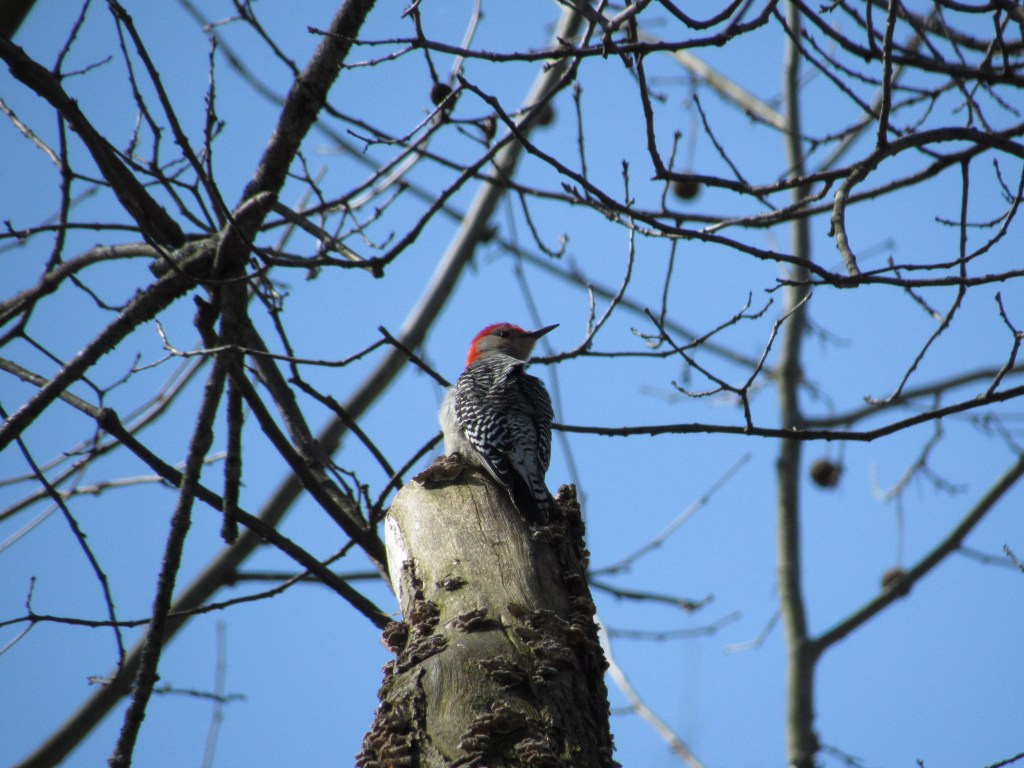


The Red-bellied Woodpecker (Melanerpes carolinus) is a striking bird native to North America, widely recognized for its colorful plumage and distinctive vocalizations. Despite its name, the red belly of this species is often quite subtle and sometimes overlooked, leading to confusion for those who might expect a brighter hue. The Red-bellied Woodpecker is primarily found in forests, woodlands, suburban areas, and sometimes even urban parks, where its characteristic drumming and loud calls frequently draw attention.
Physical Characteristics
The Red-bellied Woodpecker is a medium-sized bird, measuring between 9 to 10.5 inches (24 to 27 cm) in length, with a wingspan of around 13 to 17 inches (33 to 43 cm). Males and females have similar markings, but there are a few distinctions in coloration: the male’s red patch extends from the beak to the back of the neck, whereas the female has a red nape and crown but lacks the red forehead. Both sexes sport a black-and-white barred back and wings, which create a “ladder-like” pattern, while the underbelly is a pale, off-white with the characteristic reddish tinge that gives the bird its name.
Habitat and Range
Red-bellied Woodpeckers are typically found in the eastern United States, ranging from southern Canada to northern Florida and west to Texas. They thrive in mixed forests, deciduous forests, and even swampy woodlands but are also adaptable to suburban backyards and parks. This bird is a common sight in areas with large, mature trees, where it can drill for food and establish nesting sites. Their ability to adapt to various environments has allowed them to expand their range northward in recent decades, likely due to both climate change and an increased prevalence of bird feeders in suburban areas.
Diet and Feeding Habits
Primarily omnivorous, the Red-bellied Woodpecker’s diet includes a wide range of food sources. They forage for insects like beetles, ants, grasshoppers, and caterpillars, which they extract from tree bark using their sharp beaks. They also consume plant material, including acorns, fruits, nuts, and seeds. Their diet shifts seasonally, with more insects in warmer months and a reliance on nuts, seeds, and fruit in colder seasons. Red-bellied Woodpeckers are known to visit bird feeders, where they favor suet, sunflower seeds, and peanuts. They have also been observed storing food in crevices in trees, a behavior that helps sustain them through scarce winter months.
Behavior and Communication
Red-bellied Woodpeckers are highly vocal and use a series of calls to communicate with each other. Their repertoire includes a sharp, rolling “kwirr” or “churr” sound, along with shorter, more abrupt “cha” sounds. They are territorial birds, and during the breeding season, both males and females will defend their nests aggressively. They are also known for their drumming behavior, which they use to communicate and establish territory. This drumming is both a form of non-vocal communication and a way of locating insects within tree bark.
Reproduction and Nesting
The breeding season for Red-bellied Woodpeckers generally begins in April and can extend into July. These birds are monogamous and form pairs for the breeding season. They create nesting cavities in dead or decaying trees, where the wood is softer and easier to excavate. Nest cavities are usually located high above the ground, providing safety from predators. Both male and female participate in hollowing out the nest cavity, which may take one to two weeks to complete. Once finished, the female lays a clutch of 3 to 8 eggs, which both parents incubate over about 12 days. After hatching, the young are fed by both parents and fledge within 24 to 27 days.
Conservation Status
Red-bellied Woodpeckers are currently listed as “Least Concern” by the International Union for Conservation of Nature (IUCN), and their population is considered stable. However, habitat loss and fragmentation can impact local populations, especially in heavily urbanized areas. These woodpeckers have adapted well to human presence, but preserving mature forests and dead trees (which they use for nesting) is essential to their continued success.
Ecological Role and Importance
As insectivores, Red-bellied Woodpeckers play an important role in controlling insect populations within their habitats. They also contribute to forest ecology by creating nesting cavities that can later be used by other species, including smaller birds, mammals, and insects. Their acorn-storing behavior also aids in the dispersal of certain tree species, much like squirrels, contributing to forest regeneration.
Fun Facts
- Misleading Name: The Red-bellied Woodpecker’s red belly is often hidden or difficult to see, and it is much less prominent than the red cap or nape on its head.
- Drumming: Like other woodpeckers, the Red-bellied Woodpecker drums on trees and occasionally on metal objects, not only to locate food but also to communicate.
- Long Tongue: Their tongues can extend nearly 2 inches beyond their beaks, helping them probe for insects deep within tree crevices. The tongue has barbs and sticky saliva that aid in capturing prey.
- Memory Skills: Red-bellied Woodpeckers have impressive spatial memory and can recall the locations of food stores, which helps them survive through seasons when insects are scarce.

 Wild Bird Journal
Leave a comment