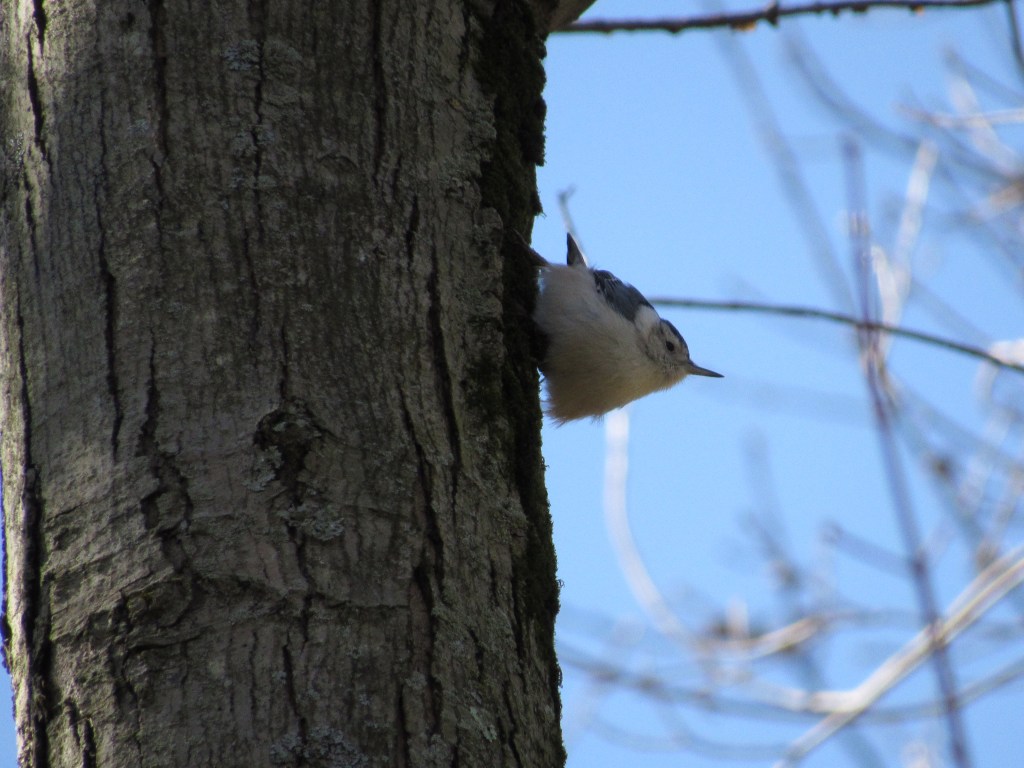


The White-breasted Nuthatch (Sitta carolinensis) is a small, active songbird found across North America, especially in forests, woodlands, and areas with plenty of mature trees. Known for its acrobatic foraging habits, this bird often appears upside-down, spiraling along tree trunks and branches while searching for food. Here’s a deeper look into its characteristics, habitat, behavior, diet, and breeding habits.
Appearance
White-breasted Nuthatches are small, about 5 to 6 inches (13-15 cm) long, with a wingspan of around 8 to 11 inches (20-28 cm). They have a stocky, compact body, short tail, and a long, pointed beak. Males and females are similar in appearance, with white underparts and a dark blue-gray back. The most striking feature is their bright white face and breast, contrasting with a black or gray cap that stretches down the nape. They also have a slight rufous tint on their lower belly and undertail.
Habitat
This bird species prefers deciduous forests with large, mature trees, often oaks, maples, and hickories. While it can be found in forests throughout the U.S. and southern Canada, it is also commonly seen in parks, orchards, and even residential areas with big trees, showcasing its versatility in habitat preferences. Their range stretches coast-to-coast across the United States and into southern Canada, from dense woodlands to open parks, making them adaptable to various environments. These birds are known for their remarkable foraging skills, as they search for insects and seeds amidst the foliage, and they often become quite vocal during the breeding season, filling the air with their lively calls. They thrive in areas that provide ample food sources and suitable nesting sites, and their presence in both urban and rural settings highlights their ability to coexist alongside human development while maintaining their natural behaviors.
Behavior
White-breasted Nuthatches are known for their nimble climbing skills and unique feeding behavior. They are excellent climbers, capable of moving headfirst down tree trunks—an unusual trait among birds, as most can only go upwards or along branches. This bird’s acrobatic ability helps it access insects and seeds hidden in bark crevices, avoiding direct competition with other species that forage differently, like woodpeckers and creepers.
They are also highly territorial and can be quite aggressive, especially during the breeding season, warding off other nuthatches or small birds from their feeding areas. They sometimes store seeds and nuts by wedging them into bark crevices for later retrieval.
Diet
White-breasted Nuthatches are omnivorous, with a diet consisting of insects, seeds, nuts, and even small fruits. In the warmer months, their diet is mostly insects and spiders, providing them with necessary protein. In winter, they switch to seeds and nuts, often from nearby bird feeders, where they can be frequent visitors. They are known to hammer seeds open using their pointed bills, a behavior that inspired the name “nuthatch.”
Breeding and Nesting
Nuthatches typically form monogamous pairs and mate for life. During the breeding season, males will perform courtship displays, often feeding the female as a bonding activity. They typically nest in tree cavities, sometimes reusing old woodpecker holes, but they can also excavate their own if necessary. The female lines the nest with soft materials, and once the eggs are laid—usually between five to nine—the female incubates them while the male brings her food.
The eggs hatch after about 12 days, and the young are ready to leave the nest in about 18 to 26 days. Both parents take turns feeding the chicks, and even after fledging, the juveniles may stay with the parents for a while to learn survival skills.
Conservation Status
White-breasted Nuthatches are currently not endangered and have a stable population. They are adaptable to human-altered landscapes and are regular visitors to backyard feeders, where they often bring an exciting splash of activity. However, habitat destruction and deforestation could threaten their natural habitat in the future.
Fun Facts
They have a characteristic call, a nasal “yank-yank,” which is easy to recognize.
White-breasted Nuthatches are highly curious birds, often willing to explore new feeders and food sources.
They use tree cavities for roosting as well as nesting, providing them with protection during cold winters.
 Wild Bird Journal
Leave a comment