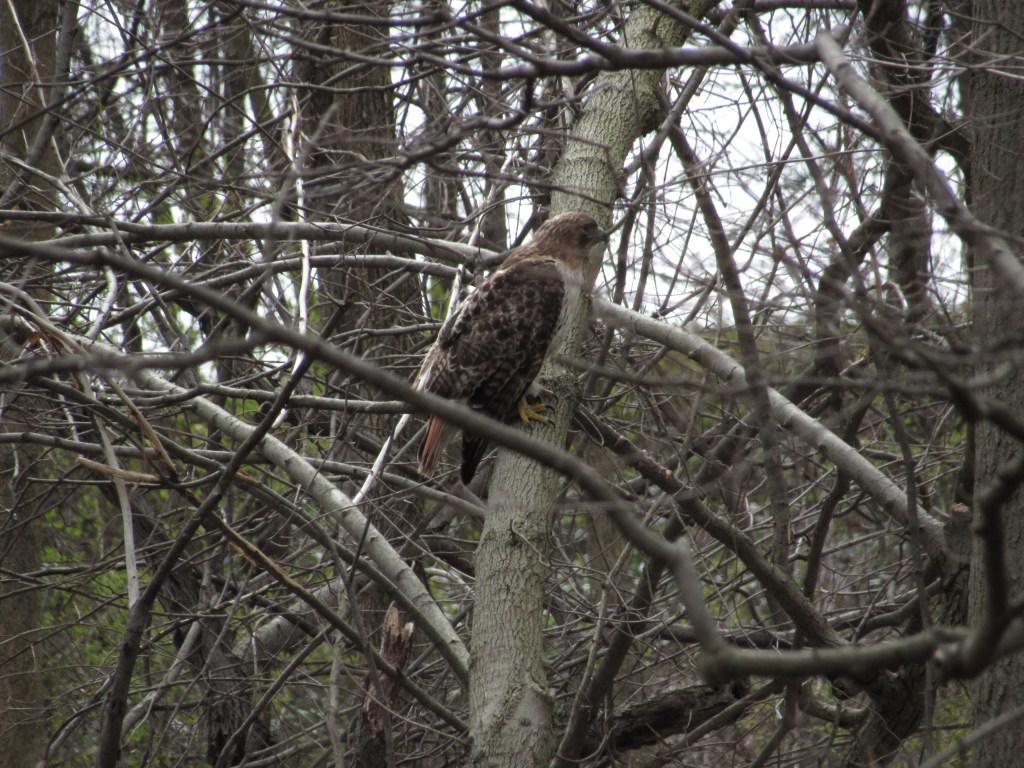


The Red-tailed Hawk (Buteo jamaicensis) is one of North America’s most widespread and adaptable birds of prey. Known for its distinct reddish-brown tail, which gives it its name, the Red-tailed Hawk is a medium- to large-sized hawk, measuring about 18 to 26 inches in length with a wingspan ranging from 3.5 to 4.5 feet. Adult females are generally larger than males, a common trait among raptors. This hawk is found across a variety of habitats, including deserts, grasslands, forests, agricultural fields, and even urban environments. Its wide adaptability has allowed it to thrive in nearly every state in the U.S., and it’s also found throughout Canada, Mexico, and parts of Central America.
Physical Characteristics
The Red-tailed Hawk’s appearance can vary by region, with over a dozen recognized subspecies. However, it typically has a brown back and a pale underside with a distinctive dark belly band and streaking, while its namesake tail is a rusty red-orange, especially in adult birds. Juvenile Red-tailed Hawks lack the reddish tail and have banded brown tails, only developing the characteristic red color after their first year.
Habitat and Range
The Red-tailed Hawk’s versatility in adapting to different habitats makes it one of the most common hawks in North America. It can be found from forests and open plains to deserts and urban environments, even nesting in cities where tall buildings mimic cliffs. They prefer areas with open spaces to hunt and tall perches, such as trees or utility poles, for nesting and watching for prey.
Diet and Hunting Behavior
Red-tailed Hawks are primarily carnivorous, with a diet that includes small mammals like rodents, rabbits, and squirrels, along with birds and reptiles. They are known to be opportunistic hunters, occasionally scavenging carrion or preying on insects if larger prey is scarce. These hawks usually hunt by soaring high above open areas, using their sharp eyesight to spot prey from hundreds of feet away. They may also perch and wait to ambush prey, often taking advantage of tall structures to gain an ideal vantage point.
Behavior and Communication
Red-tailed Hawks are known for their loud, raspy scream, a sound commonly used in movies as a stereotypical “eagle call.” This call is often used for communication between mates or to assert territory, especially during the breeding season. They are generally solitary birds but become very territorial during nesting periods. Red-tailed Hawks are also known for their soaring behavior, using thermal updrafts to circle and search for prey.
Breeding and Lifespan
Red-tailed Hawks typically mate for life, forming long-term pair bonds. During courtship, they engage in elaborate aerial displays, including steep dives, spirals, and talon-locking. Nesting begins in early spring, with pairs building large stick nests in tall trees or on cliff ledges and, increasingly, on man-made structures like buildings and towers. The female usually lays 1-5 eggs, and both parents share the duties of incubating the eggs and feeding the young. After about six weeks, the young fledge, though they often stay with their parents for several more months. In the wild, Red-tailed Hawks can live around 10-15 years, but some have been known to reach up to 30 years in captivity.
Ecological Role and Conservation Status
As apex predators, Red-tailed Hawks play an essential role in controlling populations of small mammals, which helps maintain balance in various ecosystems. They face threats from habitat loss, collisions with vehicles, and poisoning from pesticides, but they are highly adaptable and have benefited from federal protections in North America. They are currently listed as Least Concern by the IUCN, with stable populations due to their ability to thrive in diverse environments, including urban areas.
Cultural Significance
The Red-tailed Hawk holds significance in many Native American cultures, often symbolizing strength, vision, and guardianship. Some traditions view them as messengers between humans and the spirit world, while others see them as protectors or spiritual guides. They have also become iconic in popular culture, with their call frequently used in films to symbolize wilderness and freedom.
 Wild Bird Journal
Leave a comment