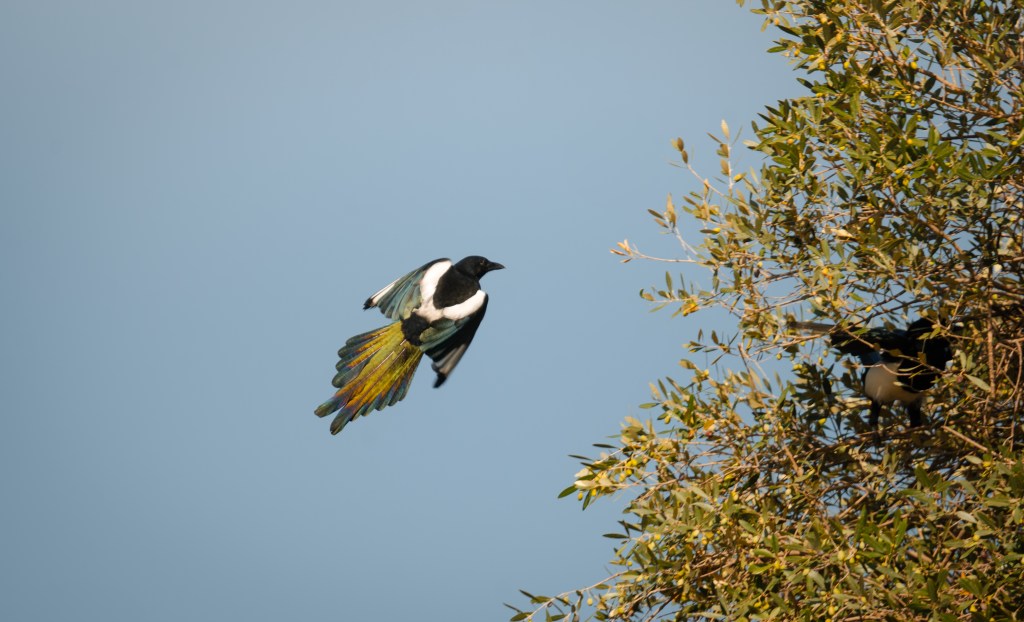


The Eurasian magpie (Pica pica) is a striking and intelligent bird with a wide range across Europe, Asia, and parts of North Africa. Known for its distinctive black and white plumage with an iridescent blue-green sheen on its wings and tail, the Eurasian magpie is part of the Corvid family, which includes crows, ravens, and jays. This bird is renowned not only for its appearance but also for its remarkable intelligence, often considered one of the most cognitively advanced non-human animals.
Physical Characteristics
The Eurasian magpie is a medium-sized bird, typically measuring about 40–46 cm (16–18 in) in length, with a wingspan of 52–60 cm (20–24 in). Its tail is notably long, often accounting for over half its total length, which aids in its unique, graceful flight pattern. The magpie’s plumage is predominantly black with white patches on its belly, shoulders, and wings. When seen up close, the black feathers reveal an iridescent blue or green sheen that changes with the angle of light.
Intelligence and Behavior
Eurasian magpies are famous for their intelligence, and studies have shown that they have cognitive abilities similar to those of great apes. They are one of the few non-mammalian species that can recognize themselves in a mirror, a trait that demonstrates self-awareness. Magpies are also known to use tools, mimic sounds, and engage in play behaviors. Their intelligence helps them adapt to a variety of environments, allowing them to solve complex problems and even develop unique survival strategies.
Magpies are often portrayed as collectors, especially of shiny objects, a behavior that has been observed but not fully substantiated. Research suggests that while they are curious about novel objects, they are not particularly attracted to shiny items as folklore suggests.
Social Structure and Communication
These birds are highly social, often seen in pairs or small family groups. Magpies have a complex social hierarchy and communicate using a range of vocalizations, body language, and behaviors. Their vocal repertoire includes loud calls, chattering sounds, and quiet warbles. Magpies are known to perform elaborate courtship displays that involve tail fanning, wing spreading, and hopping.
In winter, Eurasian magpies may form larger roosting groups, especially in urban areas where food sources are more plentiful. In rural settings, they are territorial and can become aggressive toward other birds or animals that encroach on their nesting sites.
Habitat and Distribution
Eurasian magpies are widespread throughout Europe and Asia, with populations also in North Africa. They thrive in various habitats, including woodlands, farmlands, and urban areas. They are highly adaptable and often found close to human settlements, where they scavenge food. Their adaptability to urban environments has made them common residents of cities and towns, where they benefit from the abundance of food sources and nesting sites.
Diet
Magpies are omnivorous and have a varied diet that includes insects, small mammals, carrion, seeds, fruits, and even eggs and young birds. Their diet changes seasonally, with insects and other invertebrates being the primary food source during the breeding season, while in winter, they rely more on plant-based foods and scavenging.
Reproduction and Nesting
Magpies are monogamous and form long-lasting pair bonds. They build large, dome-shaped nests in trees, often using sticks, twigs, and mud to create a sturdy structure. These nests can take weeks to construct and are often reused by the same pair year after year. The dome structure is thought to protect against predators and the elements.
Breeding season typically occurs in early spring, with females laying between 5 to 8 eggs. Both parents participate in incubating the eggs and feeding the young. Eurasian magpies are fiercely protective of their nests and will aggressively defend their territory against potential threats, including larger birds and small mammals.
Cultural Significance
Throughout history, Eurasian magpies have appeared in folklore and superstition. In European folklore, they are sometimes considered bearers of bad luck, though in other cultures, they are symbols of good fortune or happiness. In Asian cultures, particularly in Korea and China, magpies are viewed as symbols of joy and often represent good news or good luck.


 Wild Bird Journal
Leave a comment