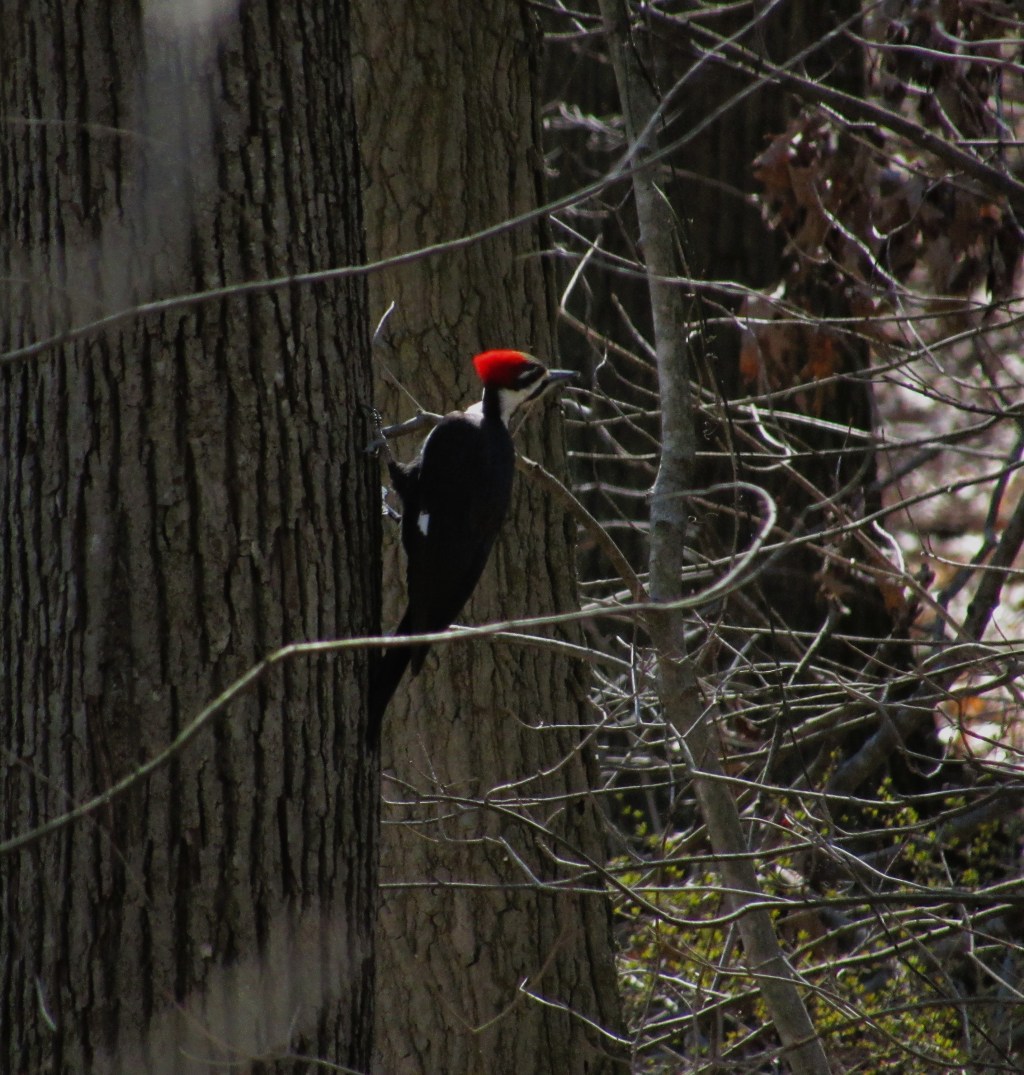


The Pileated Woodpecker (Dryocopus pileatus) is one of North America’s largest and most iconic woodpecker species. With its striking appearance, distinct call, and energetic drumming, it is a fascinating bird for ornithologists and birdwatchers alike.
Physical Description
The Pileated Woodpecker is notable for its size, measuring approximately 16 to 19 inches in length, with a wingspan of 26 to 30 inches. It is roughly crow-sized and is the largest woodpecker in the U.S. and Canada, excluding the possibly extinct Ivory-billed Woodpecker.
Key Features:
Plumage: Predominantly black with bold white stripes running down the neck. When in flight, large white patches are visible under the wings.
Crest: Its most defining feature is the bright red crest, more prominent in males.
Sexual Dimorphism: Males can be distinguished by their red forehead and a red stripe (malar stripe) extending from the beak, whereas females have a black malar stripe and a black forehead.
Beak and Feet: A chisel-like beak and zygodactyl feet (two toes pointing forward and two backward) are perfect adaptations for drilling into wood and gripping trees.
Habitat
Pileated Woodpeckers inhabit mature forests with large trees, but they also adapt to wooded suburbs and parks. They prefer deciduous or mixed forests with plenty of dead or decaying trees, which are prime spots for foraging and nesting. Their range extends across much of North America, from southern Canada to the eastern, southeastern, and Pacific Northwest United States.
Behavior and Diet
Foraging
These birds are known for their dramatic excavations in trees, often leaving rectangular holes as they search for insects. Their primary diet consists of:
Carpenter ants: Their favorite food, often extracted from deep tunnels in wood.
Wood-boring beetle larvae.
Fruits and nuts: Including wild grapes, elderberries, and acorns.
Feeding Technique
They use their powerful beaks to chip away bark and dig into trees. Their long, sticky tongue can extend far beyond their beak, equipped with barbs to capture prey.
Drumming and Communication
Instead of singing, Pileated Woodpeckers communicate through drumming and vocalizations. Their drumming serves multiple purposes:
Marking territory.
Attracting mates. Their call is a loud, resonant kuk-kuk-kuk-kuk that echoes through the forest.
Reproduction
Pileated Woodpeckers are monogamous and form long-term pair bonds. Their nesting cycle includes:
Nesting Cavity: Both males and females excavate large cavities in dead or decaying trees, typically 10-24 inches deep. These cavities are later used by other wildlife after the woodpeckers vacate them.
Eggs and Incubation: The female lays 3–5 white eggs. Both parents incubate the eggs for about 15–18 days.
Chick Rearing: Chicks are altricial (born helpless) and depend entirely on their parents for food. They fledge about 24–28 days after hatching.
Ecological Importance
Pileated Woodpeckers play a crucial role in forest ecosystems. Their nesting cavities provide shelter for other species, including wood ducks, owls, and bats. By foraging, they control insect populations and accelerate the decomposition of decaying trees.
Threats and Conservation
Challenges:
Habitat Loss: Logging and urban development reduce the availability of mature forests and dead trees.
Collisions: These birds are vulnerable to window strikes in suburban areas.
Conservation Status:
The Pileated Woodpecker is classified as a species of Least Concern by the IUCN, thanks to its stable population. However, local populations may face pressures from deforestation.
Efforts to conserve forest habitats and encourage deadwood retention are vital for their continued success.
Interesting Facts
Fossil Record: Fossils of Pileated Woodpeckers have been found dating back 1.9 million years.
Pop Culture: The Pileated Woodpecker is often thought to have inspired the cartoon character Woody Woodpecker.
Adaptability: While they prefer dense forests, they are increasingly seen in suburban and urban settings, adapting to fragmented landscapes.
 Wild Bird Journal
Leave a comment