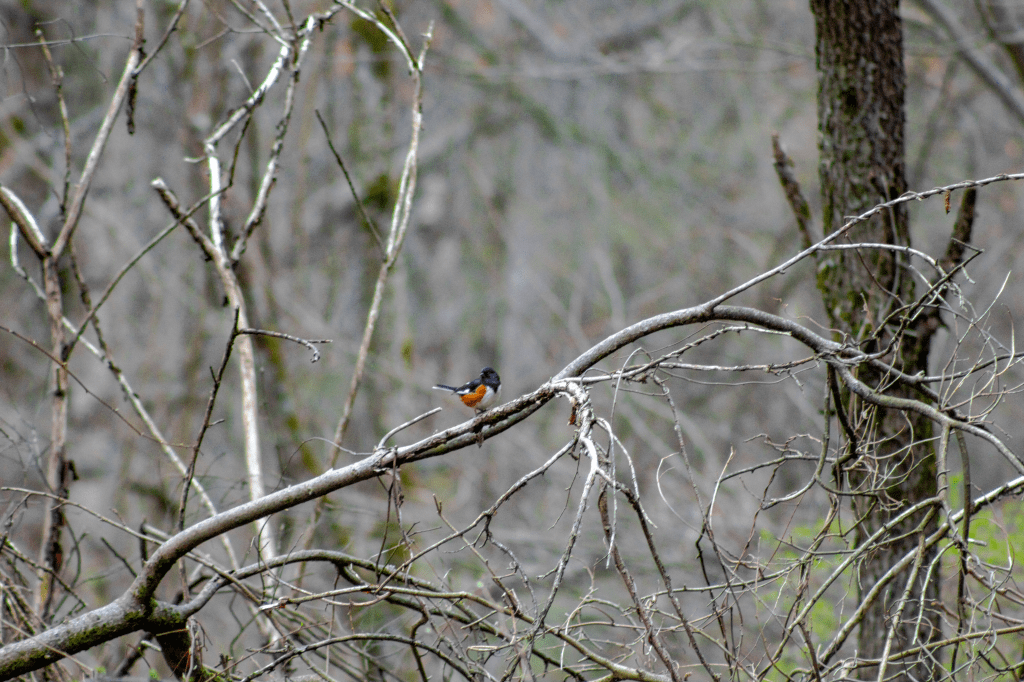


The Eastern Towhee (Pipilo erythrophthalmus) is a striking, ground-dwelling songbird belonging to the sparrow family (Passerellidae). Known for its bold black, white, and rufous plumage, as well as its distinctive “drink-your-tea!” song, the Eastern Towhee is a familiar sight in shrubby thickets, forest edges, and overgrown fields across the eastern United States.
It is one of the most easily recognized towhees, alongside its close relative, the Spotted Towhee of the western U.S.
Identification and Physical Description
Size: About 7–8.5 inches in length, making it relatively large for a sparrow. Plumage: Males: Striking black head, back, and tail, with rich reddish-brown (rufous) sides and white underparts.
Females: Similar pattern but with warm brown instead of black. Both sexes: White outer tail feathers that flash during flight or when flicked open.
Eyes: Dark red in the East, though some northern populations show paler yellowish eyes. Juveniles: Streaked brown overall, resembling young sparrows until they molt into adult plumage.
Voice and Song
Song: A distinctive, whistled “drink-your-tea!” or “tow-hee!” — slow, deliberate, and easy to recognize.
Calls: A sharp “chewink” (which inspired one of its old common names, the “Chewink”).
Range and Distribution
Breeding Range: Found throughout the eastern and southeastern United States, extending north into southern Canada (Ontario, Quebec).
Winter Range: Populations in the northern part of the range migrate southward, wintering in the southeastern U.S. and parts of Mexico. Southern populations are largely year-round residents.
Habitat Preferences
Favors dense, shrubby, and brushy areas, especially: Overgrown fields, Forest edges, Thickets and hedgerows, Regenerating clearcuts, Pine-oak woodlands. Strongly associated with low, tangled vegetation, where it spends most of its time on or near the ground.
Behavior
Foraging: Known for its “double-scratch” behavior, hopping forward and then quickly scratching backward with both feet to uncover insects, seeds, and leaf litter food.
Diet: Summer: Insects (beetles, caterpillars, ants, grasshoppers, moths. Fall/Winter: Seeds, berries, and acorns.
Territoriality: Males often sing conspicuously from exposed perches but forage secretly in dense cover.
Nesting: Builds nests on or near the ground, often hidden in shrubs or underbrush. Nests are open cups of twigs, leaves, and grass. Clutch size: Usually 2–5 eggs. Vulnerable to predators due to low nest placement.
Conservation Status
Population: Still common across much of its range. Threats: Habitat loss (removal of shrubby cover and forest understory). Nest predation from cats, snakes, raccoons, and other predators.
Nest parasitism by Brown-headed Cowbirds. IUCN Status: Least Concern, though populations have declined in parts of the Northeast due to habitat fragmentation.
Similar Species
Spotted Towhee (Pipilo maculatus): Western counterpart, similar plumage but with white spots on the wings and back.
American Robin: Larger, but shares the reddish underparts (though robins lack the bold black/white towhee contrast).
Birdwatching Tips
Best Time to See: Spring and summer when males are singing loudly from perches. Behavior to Watch For: Look for their characteristic scratching in leaf litter or the flash of white tail feathers.
Best Locations: Brushy fields, overgrown pastures, and forest edges. Eastern Towhees are abundant in the Southeast and mid-Atlantic regions, but also common in the Midwest and Northeast during summer.
Fun Facts
The Eastern Towhee’s scientific name, erythrophthalmus, means “red-eyed” in Greek, referring to its dark red eyes. Before 1995, the Eastern and Spotted Towhee were considered the same species, called the Rufous-sided Towhee.
The male’s loud, simple song makes it one of the easiest sparrow family members to identify by ear. Towhees often use their white tail feathers as a flashing signal to deter predators or communicate with other towhees.

 Wild Bird Journal
Leave a comment