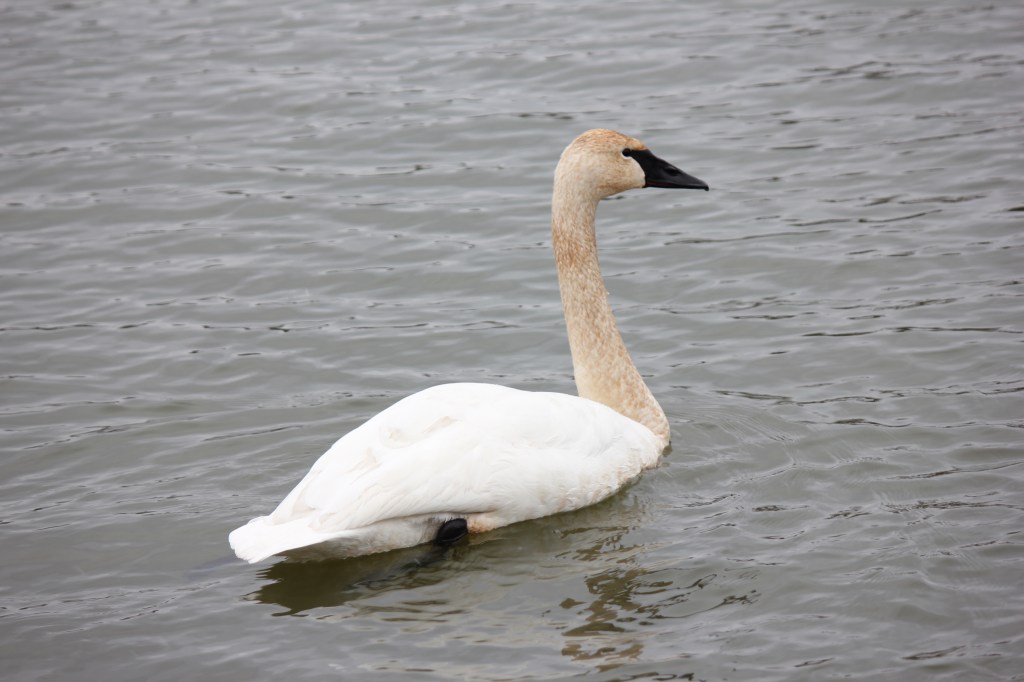


The Trumpeter Swan is the largest species of waterfowl in North America and one of the heaviest flying birds in the world. Known for its striking white plumage, long graceful neck, and deep, resonant call, this majestic bird has captured the attention of bird watchers, conservationists, and nature lovers alike.
Physical Characteristics
- Size:
- Adult Trumpeter Swans measure between 4.6 to 5.9 feet (1.4 to 1.8 meters) in length.
- Their wingspan ranges from 6.5 to 8.2 feet (2 to 2.5 meters), making them one of the birds with the largest wingspans in North America.
- They weigh between 15 to 30 pounds (6.8 to 13.6 kg), with males being slightly larger than females.
- Plumage:
- Adults are entirely white with black legs and feet.
- Juveniles (called cygnets) are grayish-brown and gradually acquire their white feathers over the first year.
- Bill:
- The Trumpeter Swan has a long, straight black bill that often has a slight red border at the base.
- The bill’s shape and color help distinguish it from the similar-looking Tundra Swan, which has a yellow patch near the eyes.
Habitat and Distribution
Historically, Trumpeter Swans were widespread across North America, but habitat loss and overhunting during the 19th and early 20th centuries led to a dramatic decline in their population. By the early 1900s, they were believed to be nearly extinct, with only a few populations surviving in remote areas of the Rocky Mountains and Alaska.
Current Range
Thanks to extensive conservation efforts, Trumpeter Swans have rebounded significantly and can now be found in:
- Alaska
- Western Canada (British Columbia, Alberta, Yukon, and Northwest Territories)
- Northern United States (particularly in the Pacific Northwest, Great Lakes region, and northern Rocky Mountains)
During winter, they migrate to areas with open water, such as:
- Coastal estuaries
- Inland lakes and rivers that remain unfrozen
Preferred Habitat
They inhabit shallow lakes, ponds, marshes, and slow-moving rivers with abundant aquatic vegetation. Wetlands with emergent vegetation are particularly important for nesting and feeding.
Diet
Trumpeter Swans are primarily herbivorous. Their diet varies based on the season and habitat:
- Spring and Summer:
They feed on submerged aquatic plants such as pondweeds, water lilies, and algae. - Autumn and Winter:
During migration or in areas with limited aquatic vegetation, they may consume grains and other crops in nearby fields.
Swans use their long necks to reach underwater plants, often submerging their heads completely while feeding.
Behavior and Ecology
- Social Structure:
Trumpeter Swans are monogamous, forming lifelong pair bonds. Pairs establish and defend territories during the breeding season. - Breeding:
- Breeding typically begins in late spring (April to June).
- Nests are large mounds built from vegetation and lined with down. They are usually situated near water to provide easy access to food and escape routes from predators.
- The female lays 4 to 6 eggs, which she incubates for about 32 to 37 days.
- Cygnets are precocial, meaning they can swim and feed themselves shortly after hatching but remain with their parents for several months.
- Migration:
Trumpeter Swans are partial migrants. While some populations in milder climates remain year-round, those breeding in colder regions migrate south to avoid frozen waters.
Vocalization
The Trumpeter Swan’s name comes from its loud, trumpet-like call, which can carry over long distances. These calls are often heard during flight and are used to maintain contact with other swans, signal alarm, or reinforce pair bonds.
Conservation Status
The Trumpeter Swan was once considered critically endangered due to hunting and habitat loss. Conservation efforts, including habitat restoration, hunting regulations, and the establishment of protected areas, have played a crucial role in their recovery. Today, their population is stable or increasing, and they are listed as a species of Least Concern by the IUCN.
Key Conservation Efforts
- Captive Breeding and Reintroduction:
Programs in the U.S. and Canada have successfully reintroduced Trumpeter Swans to areas where they had been extirpated. - Wetland Protection:
Preservation and restoration of wetland habitats have been crucial for their resurgence. - Monitoring and Research:
Ongoing studies track population trends, migration patterns, and habitat use to inform future conservation strategies.
Cultural Significance
Throughout history, Trumpeter Swans have been admired for their elegance and grace. They appear in various myths and folklore, often symbolizing love, purity, and fidelity. In modern times, they serve as a flagship species for wetland conservation and are a favorite subject for wildlife photographers and bird watchers.
Interesting Facts
Trumpeter Swans can live up to 20 to 30 years in the wild, with some individuals in captivity living even longer.
They require large stretches of water for takeoff due to their size and weight, often running across the water’s surface to gain enough speed for flight.
Despite their large size, they are strong fliers, capable of flying at speeds up to 50 miles per hour (80 km/h).
A group of swans on the ground is called a bevy, while a group in flight is called a wedge.


 Wild Bird Journal
Leave a reply to festivalwildly0565641a15 Cancel reply