
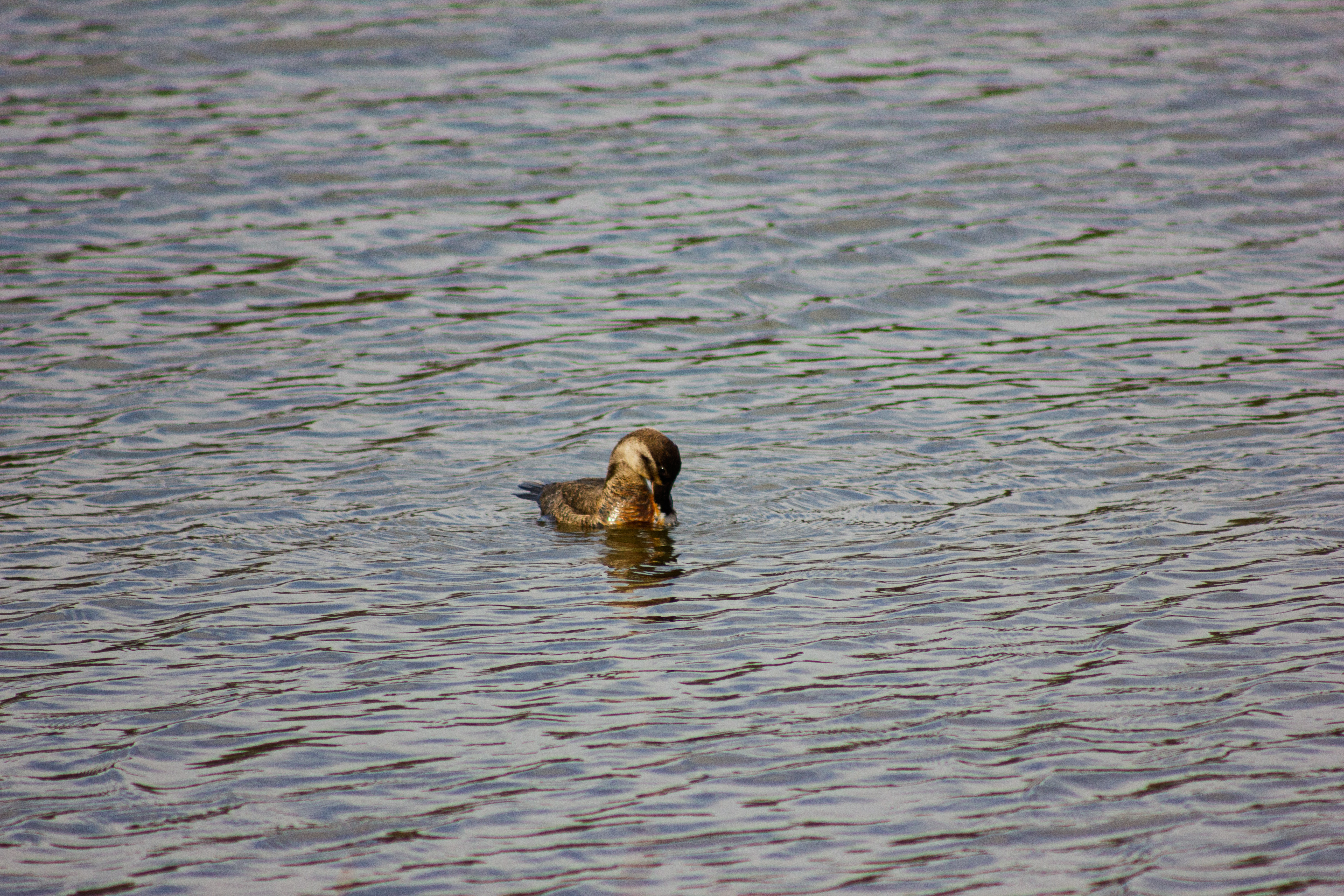


The ruddy duck (Oxyura jamaicensis) is a small, stout freshwater diving duck native to North America and parts of Central America. It is most easily recognized by the male’s striking bright chestnut body, sky-blue bill, and stiff, upright tail, often held cocked.
Description
Male (breeding plumage):Bright chestnut body. White cheeks, Blackish head and crown, Bright blue bill, Stiff tail often held erect.
Female and nonbreeding male: Grayish-brown plumage, Dark cap and cheek stripe,Grayish bill
They are small ducks, about 35–40 cm (14–16 in) in length, with a wingspan of about 60 cm (24 in) and a weight of 400–800 grams (14–28 oz).
Range & Distribution
Breeding range: North America, especially the prairie pothole region of Canada and the northern U.S., as well as the western U.S.
Wintering range: Southern U.S., Mexico, Central America, and the Caribbean.
Introduced range: UK and Europe: Ruddy ducks were introduced into the UK in the 20th century and quickly established wild populations. However, due to their tendency to hybridize with the endangered white-headed duck (O. leucocephala), culling programs have been implemented across Europe.
Habitat
Ruddy ducks prefer shallow freshwater wetlands with abundant emergent vegetation, such as cattails and reeds. In winter, they are found in more open water habitats, including lakes, reservoirs, estuaries, and coastal marshes.
Behavior
Feeding: Diet consists of aquatic invertebrates (like insect larvae, crustaceans, and mollusks), seeds, and plant material. Forages by diving, often staying submerged for extended periods.
Breeding: Breeding season starts in late spring. Males perform elaborate courtship displays involving bill-bubbling and head-pumping. Nest is built by the female in dense marsh vegetation, usually a floating platform of plant material. Females lay 5–15 eggs, which are large relative to body size.
Incubation lasts about 23–26 days. Ducklings are precocial and leave the nest soon after hatching. Migration: Most populations are migratory, especially those in northern breeding ranges.
Vocalizations
Generally silent, but males may produce a low mechanical popping sound or a nasal call during courtship.
Conservation Status
IUCN Red List: Least Concern.
Population trend: Stable in North America, but controlled in Europe due to hybridization threats.
Threats: Habitat loss, oil spills, and hunting (in some areas). In Europe, conservationists consider the ruddy duck invasive due to its hybridization with native white-headed ducks.
Unique Features
Stiff tail: Used for steering underwater and often held upright at rest.
Courtship display: One of the most unique among ducks—males beat their chest with their bill to create bubbles and perform a popping display to impress females.
Bill color change: Males’ bills change from dull gray to bright blue during the breeding season.
Interesting Facts
The ruddy duck lays some of the largest eggs in relation to its body size of any duck species.
Their legs are set far back on the body, which aids in diving but makes them clumsy on land.
The ruddy duck has been part of intensive control efforts in Europe to protect the white-headed duck from extinction due to hybridization.
Leave a Reply