
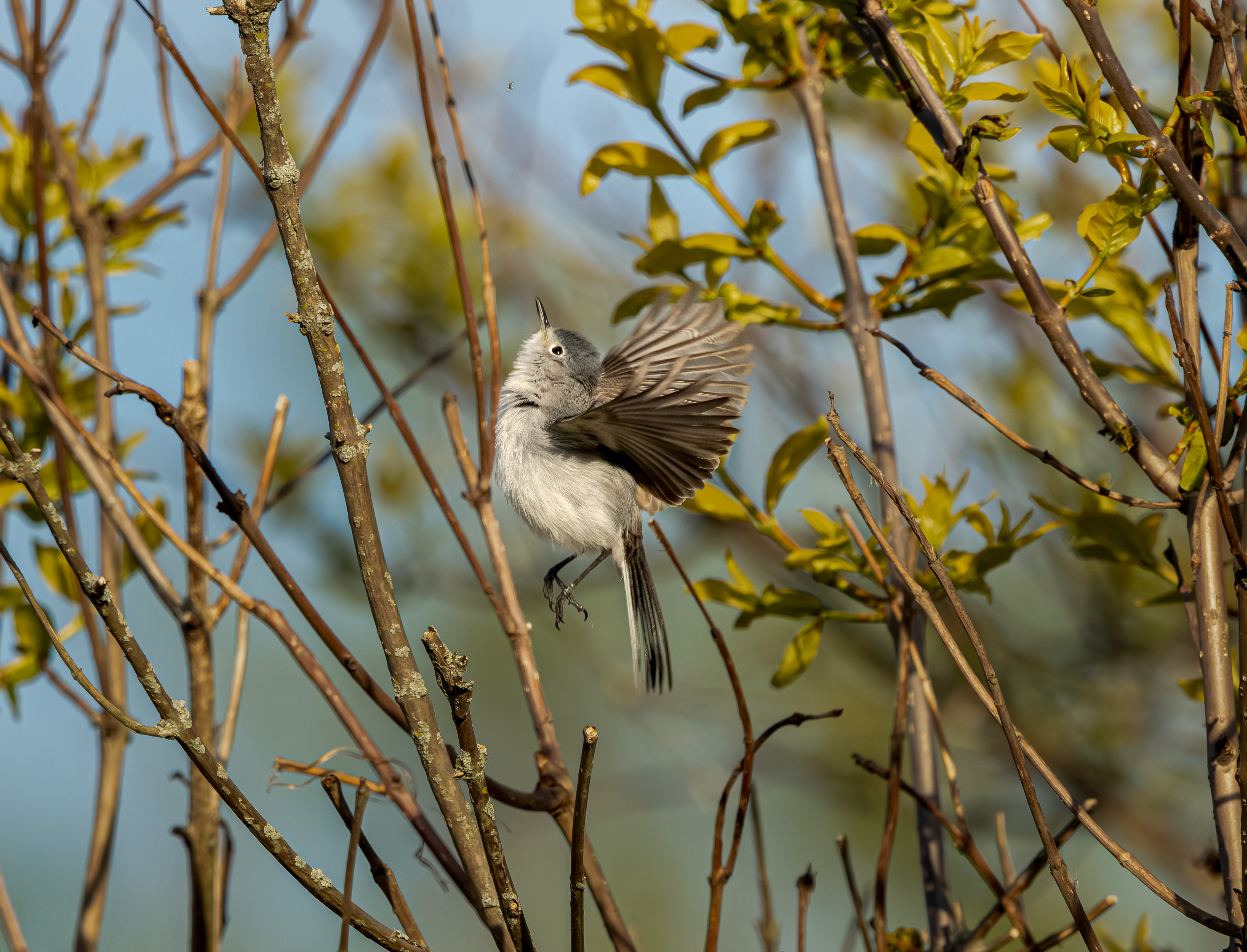


If you’re a birder or photographer trying to identify that tiny blue‑gray bird flitting through the branches, this guide will help you recognize, find, and photograph the Blue-gray Gnatcatcher.
The Blue-gray Gnatcatcher is one of North America’s most energetic and recognizable small songbirds. Known for its soft blue-gray plumage, long black-and-white tail, and constant motion, this tiny insect-eating bird is a favorite among birdwatchers, wildlife photographers, and backyard birding enthusiasts. Found throughout much of the United States during spring and summer, the Blue-gray Gnatcatcher thrives in forests, woodland edges, parks, and riparian habitats.
What Is a Blue-gray Gnatcatcher?
The Blue-gray Gnatcatcher (Polioptila caerulea) is a tiny migratory songbird belonging to the family Polioptilidae. Despite its small size, it is extremely active and easy to identify due to its restless movements and distinctive tail flicking behavior.
Quick Facts About the Blue-gray Gnatcatcher
Scientific Name: Polioptila caerulea
Family: Polioptilidae
Length: 4–5 inches
Wingspan: 6–7 inches
Weight: 5–7 grams
Diet: Insects and spiders
Habitat: Deciduous forests woodland edges, swamps, parks
Migration: Long-distance migrant
Conservation Status: Least Concern.
Blue-gray Gnatcatcher Identification
Appearance
The Blue-gray Gnatcatcher has:
Soft blue-gray upperparts, Pale white underparts, Thin black bill, Bright white eye ring, Long black tail with bold white outer feathers, Slim body and compact shape.
Male Blue-gray Gnatcatchers develop a thin black eyebrow stripe during breeding season, making them easier to distinguish from females.
Size Comparison
This bird is smaller than many warblers and only slightly larger than a kinglet. Its lightweight body and hyperactive behavior often make it appear almost weightless as it moves through trees.
Blue-gray Gnatcatcher Habitat
The Blue-gray Gnatcatcher prefers: Open deciduous woodlands, Forest edges, River corridors, Bottomland forests, Oak and maple forests, Mature suburban parks, Wetland edges.
During migration, these birds may stop in nearly any wooded habitat with abundant insects.
Blue-gray Gnatcatcher Range
Where Do Blue-gray Gnatcatchers Live?
Summer Breeding Range
The Blue-gray Gnatcatcher breeds across much of: Eastern United States, Midwest, Southern Canada, Great Plains, Parts of the Southwest.
Winter Range
During winter, they migrate to: Southern Florida, Mexico, Central America, Caribbean regions.
Blue-gray Gnatcatcher Migration
Blue-gray Gnatcatchers are long-distance migrants. In spring, they return north relatively early, often arriving in April across Ohio and the Midwest. Birdwatchers frequently search for Blue-gray Gnatcatchers during spring migration because their active feeding behavior makes them exciting to observe.
Migration Timing
Spring Migration: March–May. Fall Migration: August–October.
Blue-gray Gnatcatcher Behavior
Tail Flicking
One of the most recognizable behaviors of the Blue-gray Gnatcatcher is its constant tail flicking. The bird spreads its black-and-white tail repeatedly while foraging. Researchers believe this may help flush insects from leaves and branches.
Feeding Style
Blue-gray Gnatcatchers rarely stay still. They hop rapidly through branches,Hover briefly like tiny flycatchers, Pick insects from leaves, Chase flying insects mid-air.
Their speed and agility make them difficult but rewarding to photograph.
What Does a Blue-gray Gnatcatcher Eat?
The Blue-gray Gnatcatcher primarily eats: Gnats, Small flies (as seen photographed),Caterpillars, Beetles, Moths, Spiders, Leafhoppers.
During late summer and migration, they may occasionally consume berries. These birds are highly beneficial because they help control insect populations naturally.
Blue-gray Gnatcatcher Nest
Nest Construction
The Blue-gray Gnatcatcher builds one of the most impressive nests among small songbirds.
Their nests are: Tiny cup-shaped structures, Covered with lichen, Bound together using spider silk, Camouflaged to resemble tree knots, Nests are typically placed high in deciduous trees.
Eggs
Females usually lay: 3–5 pale blue eggs, Speckled lightly with brown markings.
Both parents help care for the young.
Blue-gray Gnatcatcher Song and Calls
The Blue-gray Gnatcatcher has a thin, nasal voice often described as: “speee”, “zeee”, “tsit”.
Its song is soft, rapid, and wheezy, often overlooked unless heard nearby. Birders frequently identify this species first by sound before spotting it visually.
How to Attract Blue-gray Gnatcatchers
Although they rarely visit seed feeders, you can attract Blue-gray Gnatcatchers by creating bird-friendly habitat.
Best Ways to Attract Them
Plant native trees, Maintain woodland edges, Avoid pesticides, Encourage insects naturally, Provide water features, Grow oak trees and shrubs. Native landscaping significantly improves habitat quality for insectivorous songbirds.
Blue-gray Gnatcatcher Photography Tips
The Blue-gray Gnatcatcher is a challenging but rewarding bird to photograph.
Best Photography Tips
Use fast shutter speeds, Focus on branches ahead of movement, Shoot during early morning light, Watch for tail flicking patterns, Track them along woodland edges. Their nonstop movement makes autofocus performance especially important for bird photography.
Blue-gray Gnatcatcher Fun Facts
Blue-gray Gnatcatchers use spider silk in nest construction. They can hover briefly while catching insects. Their nests stretch as chicks grow. They are closely related to gnatwrens and gnatwrens of Central America. Despite their tiny size, they migrate hundreds of miles annually.
Leave a Reply