
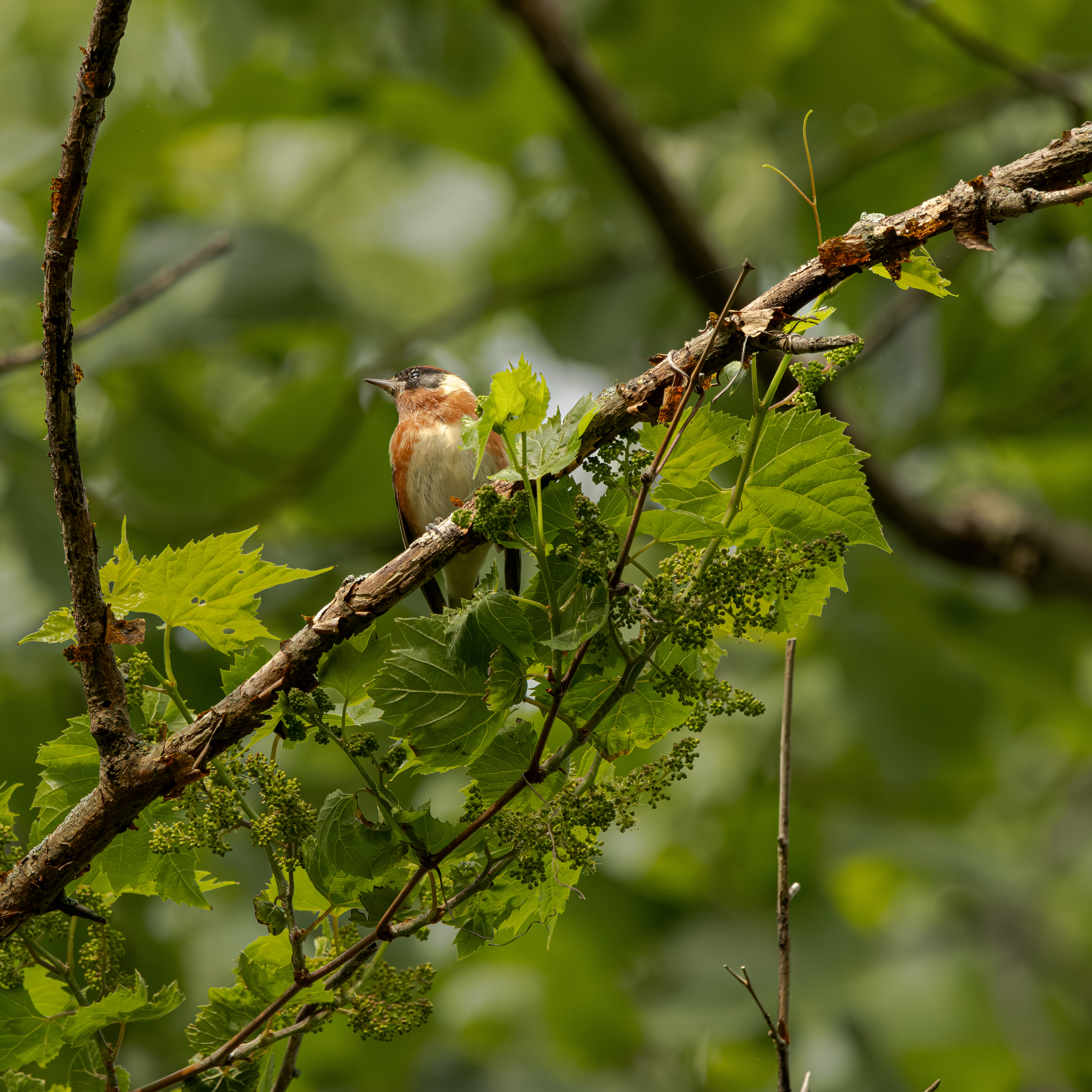


The Bay-breasted Warbler (Setophaga castanea) is one of North America’s most striking migratory songbirds. Known for its rich chestnut-colored breeding plumage and remarkable long-distance migration, this small warbler captivates birdwatchers across eastern North America during spring and fall migration.
Although not as common in backyard habitats as some other warblers, the Bay-breasted Warbler is highly sought after by birders due to its beautiful coloration, unique migration patterns, and association with northern boreal forests. During peak migration, these birds can be found moving through woodlands, parks, and forest edges as they travel between their breeding grounds in Canada and wintering areas in Central and South America.
Bay-breasted Warbler Identification
Adult Male (Breeding Plumage)
Breeding male Bay-breasted Warblers are among the most colorful warblers in North America.
Key field marks include: Deep chestnut throat, breast, and flanks, Black face and crown, Cream or buff-colored neck patch, Olive-green back, Two distinct white wing bars, Dark streaking on the back, Black legs and bill.
The rich chestnut coloration gives the species its name and makes breeding males relatively easy to identify.
Adult Female
Females appear more subdued than males but still possess: Warm buff-colored underparts, Olive-green upperparts, Pale wing bars, Faint chestnut wash on the flanks, Less pronounced facial markings.
Nonbreeding Plumage
Fall Bay-breasted Warblers often confuse birders because they lose much of their chestnut coloration. Look for: Greenish upperparts, Buffy sides, Yellow-green face, White wing bars, Stocky appearance compared to many warblers.
Size
Length: 5.1–5.9 inches (13–15 cm), Wingspan: 8.7–9.4 inches (22–24 cm), Weight: 0.3–0.5 ounces (8–15 g).
Bay-breasted Warblers are slightly larger and chunkier than many other wood warblers.
Bay-breasted Warbler Range
Breeding Range
Bay-breasted Warblers breed primarily in: Central Canada, Northern Ontario, Quebec, Newfoundland, Nova Scotia, New Brunswick, Boreal forests across Canada.
Small populations also breed in: Northern Minnesota, Northern Wisconsin, Northern Michigan.
Migration Range
During migration, they can be observed throughout: Ohio, Pennsylvania,New York, Michigan, Indiana,Illinois, New England, Mid-Atlantic states.
Birders in the Great Lakes region often encounter Bay-breasted Warblers during spring migration from late April through May.
Winter Range
Wintering areas include: Panama, Costa Rica, Nicaragua, Colombia, Venezuela, Northern South America.
Unlike many warblers, Bay-breasted Warblers often winter in tropical forests at various elevations.
Bay-breasted Warbler Diet
Bay-breasted Warblers are primarily insectivorous.
Their diet consists of: Caterpillars, Moths, Beetles, Spiders, Flies, Mosquitoes, Aphids, Spruce budworms.
During migration and winter, they supplement their diet with: Berries, Fruits, Nectar.
One reason populations fluctuate significantly is their strong dependence on spruce budworm abundance in breeding habitats.
Bay-breasted Warbler Behavior
Bay-breasted Warblers are active canopy foragers.
Typical behaviors include: Gleaning insects from foliage, Hovering briefly to catch prey, Moving methodically through treetops, Joining mixed-species feeding flocks.
Unlike hyperactive species such as the American Redstart, Bay-breasted Warblers often move more deliberately while foraging.
Bay-breasted Warbler Song and Calls
Song
The Bay-breasted Warbler’s song is a high-pitched series of thin notes often described as:
“tsee-tsee-tsee-tsee-tsee-tsee-tsee”
Because of its high frequency, older birders may have difficulty hearing the full song.
Call
Common call notes include: Sharp “chip”, Soft “seep”, Thin migration calls heard at night.
Learning these vocalizations can greatly improve detection during migration.
Bay-breasted Warbler Nesting
Nest Location
Females construct nests: In spruce trees, Fir trees, Conifer branches, Hidden among dense foliage.
Nest Construction
Materials include: Moss, Twigs, Grass, Bark strips, Rootlets.
Eggs
Typical clutch size: 4–7 eggs, Egg color: Pale greenish-white, Speckled with brown markings.
Incubation
Approximately 12 days
Fledging
Young typically leave the nest:9–11 days after hatching
Bay-breasted Warbler Migration
The Bay-breasted Warbler undertakes one of the most impressive migrations among North American songbirds.
Some individuals travel: Over 4,000 miles annually, From Canadian boreal forests to northern South America.
Many migrate through: Great Lakes region, Atlantic Coast flyway, Gulf Coast migration corridors.
Peak spring migration generally occurs during May, making this one of the best months to search for the species.
Conservation Status
The Bay-breasted Warbler is currently listed as a species of Least Concern, but populations have experienced fluctuations.
Threats include: Habitat loss, Climate change, Boreal forest degradation, Reduced spruce budworm cycles, Deforestation on wintering grounds.
Conservation of large boreal forest ecosystems remains critical for maintaining healthy populations.
Bird Photography Tips for Bay-breasted Warblers
Photographing Bay-breasted Warblers can be challenging because they spend much of their time high in the forest canopy.
Best Photography Tips
Visit migration hotspots during May. Arrive shortly after sunrise. Search flowering trees attracting insects. Use continuous autofocus tracking. Shoot at 1/1000 second or faster. Watch mixed warbler flocks. Position yourself with the sun behind you.
Camera Settings
For perched birds: Shutter Speed: 1/1000–1/2000 sec, Aperture: f/5.6–f/8, ISO: 400–1600 depending on light.
Where to Find Bay-breasted Warblers in Ohio
Ohio birders can find Bay-breasted Warblers during migration at: Magee Marsh Wildlife Area, Ottawa National Wildlife Refuge, Headlands Beach State Park, Lakeshore Reservation, Cuyahoga Valley National Park, Lake Erie shoreline hotspots.
The best viewing period is generally from early May through late May.
Interesting Facts About Bay-breasted Warblers
Bay-breasted Warblers depend heavily on spruce budworm outbreaks. Their population size can fluctuate dramatically from year to year. They are one of the most sought-after spring warblers in eastern North America. Breeding males display one of the richest chestnut colorations of any North American songbird. They travel thousands of miles between Canada and South America each year. Fall Bay-breasted Warblers look completely different from spring birds, making identification challenging. They are closely related to Blackpoll Warblers and Blackburnian Warblers.
Conclusion
The Bay-breasted Warbler is a stunning migratory songbird that highlights the incredible diversity of North America’s warblers. From its vibrant chestnut breeding plumage to its remarkable migration from Canada to South America, this species remains a favorite among birdwatchers and wildlife photographers. Whether you’re searching for warblers at Magee Marsh, exploring a local migration hotspot, or photographing songbirds in spring, spotting a Bay-breasted Warbler is always a memorable experience.
Leave a Reply