
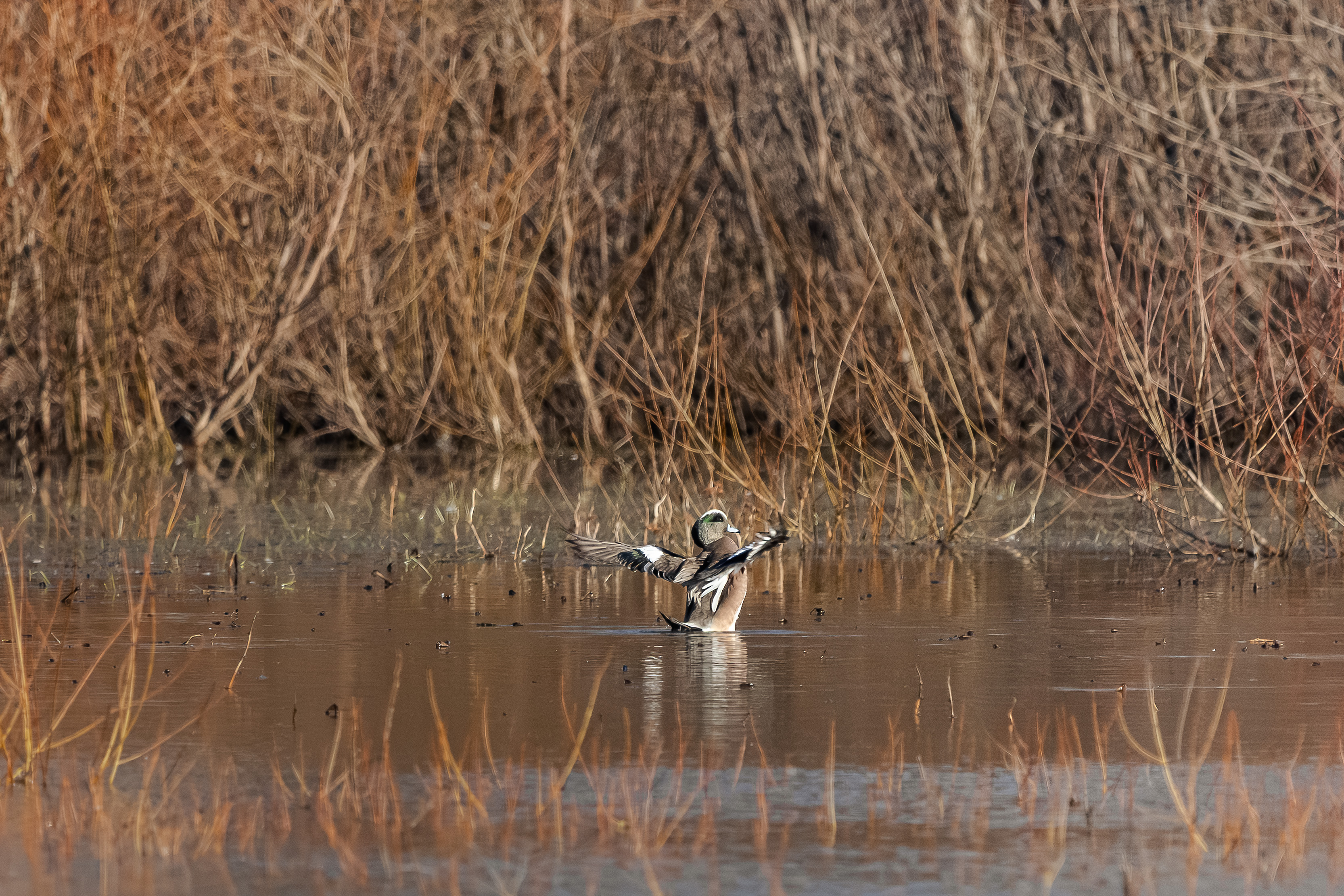


The American Wigeon is a colorful dabbling duck found across North America. It is known for its rounded head, short bill, compact body, and distinctive whistling call.
Male American Wigeons are easy to recognize during the breeding season. They have a pale crown, a green patch behind the eye, and a warm pinkish-brown body.
Female American Wigeons are more subtly colored. They have warm brown plumage, a grayish head, and a short blue-gray bill with a black tip.
American Wigeons are often found on lakes, ponds, marshes, rivers, bays, and flooded fields. They also spend more time grazing on land than most other ducks.
Their scientific name is Mareca americana.
American Wigeon Identification
The American Wigeon is a medium-sized dabbling duck. It has a compact body and a short neck. Its head looks rounded. Its bill is noticeably shorter than the bills of many other ducks. American Wigeons are usually smaller than Mallards. They are larger than Green-winged Teal. Their shape can be one of the best identification clues.
They often sit low in the water. Their heads may appear close to their bodies. The bill is pale blue-gray. It has a small black tip. This bill shape helps the bird clip grasses and aquatic plants. American Wigeons often gather with Gadwalls, Mallards, Northern Pintails, American Coots, and other waterfowl.
Male American Wigeon Identification
A breeding male American Wigeon is very distinctive. The male has a broad green patch behind each eye. The green color can look bright in direct sunlight. It can appear dark or almost black in poor lighting. The top of the male’s head is pale cream or white. This pale crown gave the species the nickname baldpate.
The male’s breast and sides are pinkish-brown or cinnamon-colored. The back is grayish. The rear of the body has bold white areas and a black undertail. The male also has a large white patch on the upper wing. This patch is often easy to see when the bird flies or stretches its wings.
During late summer, male American Wigeons enter eclipse plumage. Their colors become duller. They may begin to resemble females. Eclipse males can still show traces of the pale crown or green eye patch. Their white wing patches can also help confirm their identity.
Female American Wigeon Identification
Female American Wigeons are covered in warm brown and reddish-brown plumage. Their heads are usually grayish or brownish. A darker patch may appear around the eye. The bill is short and pale blue-gray. The tip of the bill is black.
The female’s short bill is an important field mark. It separates her from female Gadwalls, Mallards, and many other brown ducks. Female American Wigeons have rounded heads and compact bodies. Their wing pattern is darker than the male’s. A narrow white border may be visible when they fly.
Juvenile American Wigeons look similar to adult females. Young males gradually develop pale feathers on the crown and green feathers near the eye.
American Wigeon Call
The American Wigeon is a vocal duck. The male makes a high, clear whistle. The call is often written as “whew-whee-whew.” The whistle sounds airy and slightly squeaky. It can carry across open water. A large flock may create a constant series of whistles.
Birders often hear American Wigeons before they see them. Females make lower and rougher sounds. These include nasal quacks, croaks, and short calls. Learning the American Wigeon call can make the species much easier to locate.
American Wigeon Habitat
American Wigeons use many different wetland habitats. They live on shallow lakes, ponds, marshes, slow-moving rivers, and reservoirs. They also use coastal bays, estuaries, salt marshes, and tidal areas during migration and winter.
American Wigeons prefer areas with abundant aquatic vegetation. Shallow water allows them to reach plants near the surface. They also visit flooded agricultural fields. These areas may provide seeds, grasses, and leftover grain.
American Wigeons are often seen feeding on lawns, parks, pastures, and golf courses near water. During the breeding season, they use northern wetlands surrounded by grasslands, forests, or tundra.
American Wigeon Range
The American Wigeon is found throughout much of North America. Its breeding range is concentrated across Alaska, western Canada, central Canada, and parts of the northern United States. Many American Wigeons breed in wetlands near the boreal forest and northern prairies.
During migration, the species can appear across most of the United States and southern Canada. Large numbers winter along the Pacific Coast. They are also common in California, Texas, the Gulf Coast, Mexico, and parts of the Atlantic Coast.
Some birds travel into Central America and the Caribbean. American Wigeons occasionally appear in Europe and Asia. These birds are considered rare visitors outside North America.
American Wigeon Migration
Most American Wigeons migrate between northern breeding grounds and southern wintering areas. Fall migration can begin in late August or September.
The exact timing depends on temperature, food, water levels, and location. American Wigeons may travel in small groups during spring. Fall flocks can be much larger. They stop at marshes, reservoirs, rivers, flooded fields, and coastal wetlands during migration.
These stopover habitats provide food and safe places to rest. Spring migration begins as northern lakes and wetlands start to thaw. The birds then return to breeding areas in Alaska, Canada, and the northern United States.
What Do American Wigeons Eat?
American Wigeons eat mostly plants. Their diet includes grasses, pondweed, duckweed, sedges, algae, and other aquatic vegetation. They also eat seeds and agricultural grains. Rice, wheat, and barley may be eaten in fields.
During the breeding season, females eat more insects and aquatic invertebrates. These foods provide protein for egg production. Ducklings also eat insects and small aquatic animals. This protein helps them grow quickly.
Adult American Wigeons may eat snails, crustaceans, beetles, midges, and other small invertebrates. Plant material remains the most important part of the adult diet.
American Wigeon Feeding Behavior
American Wigeons feed in several ways. They often swim across shallow water and pick plants from the surface. They may also tip forward. The tail points upward while the head reaches underwater. American Wigeons rarely dive deeply.
They are dabbling ducks rather than true diving ducks. They frequently leave the water to graze. Their short bills are well suited for clipping grass. Their legs are positioned farther forward than the legs of many diving ducks. This allows them to walk and run more easily on land.
American Wigeons also feed near American Coots and diving ducks. Coots pull underwater plants to the surface. Wigeons sometimes grab pieces before the coots can eat them. This behavior has earned the American Wigeon the nicknames robber duck and poacher duck.
American Wigeon Nesting
American Wigeons nest on the ground. The female usually selects a hidden area with tall grass, sedges, or low shrubs. The nest may be near water. It can also be several hundred feet away. The female creates a shallow depression in the ground. She lines it with grasses, leaves, plant stems, and down feathers. An American Wigeon usually lays about eight to eleven eggs. The eggs are pale cream or whitish. The female performs the incubation. Incubation usually lasts between 22 and 28 days. The male normally leaves before the eggs hatch.
American Wigeon Ducklings
American Wigeon ducklings are active soon after hatching. They are covered in down. Their eyes are open. They can walk and swim within a short time. The female leads the ducklings from the nest to nearby water. The young birds feed themselves. The female remains close and protects them. Ducklings eat insects, small invertebrates, and plant material. They gradually become more independent as they grow. Young American Wigeons usually become capable of flight after about six to nine weeks.
American Wigeon Behavior
American Wigeons are social outside the breeding season. They gather in flocks that may contain dozens or hundreds of birds. They often mix with other duck species. American Wigeons can be wary. A flock may suddenly take flight when disturbed. They rise quickly from the water. Their flight is fast and direct. The white wing patches of adult males are easy to see in flight. American Wigeons also spend time resting on open water. They may remain close together while sleeping or preening. Heavy human disturbance can change their behavior. Some flocks may begin feeding more often at night.
American Wigeon vs. Eurasian Wigeon
The Eurasian Wigeon is the species most likely to be confused with the American Wigeon. A male Eurasian Wigeon has a reddish or chestnut-colored head. It has a pale cream forehead and a mostly gray body. A male American Wigeon has a grayish head. It has a green patch behind the eye and a pale crown. Female American and Eurasian Wigeons are harder to separate. Birders should study the bill color, head shape, body color, and wing pattern. Eurasian Wigeons occasionally join American Wigeon flocks in North America. They are reported most often along the Pacific Coast.
American Wigeon vs. Gadwall
Female American Wigeons can resemble female Gadwalls. The American Wigeon has a shorter bill. The bill is pale blue-gray with a black tip. A female Gadwall has a longer bill. Orange may appear along the sides. Gadwalls also have more detailed feather patterns across the body. The American Wigeon usually looks warmer, rounder, and more compact. Male Gadwalls are gray with a black rear. They do not have the green eye patch or pale crown of a male American Wigeon.
Best Time to See American Wigeons
In much of the United States, American Wigeons are easiest to find during fall, winter, and early spring. In Canada and Alaska, they are more common during spring, summer, and fall. The best places to look are shallow wetlands with heavy plant growth. Reservoirs, marshes, protected bays, wildlife refuges, and flooded fields can all be productive. Look closely at flocks of American Coots. American Wigeons often feed beside them. Also check nearby lawns and grassy shorelines. Wigeons may be grazing away from the water. Early morning and late afternoon often provide good birding and photography conditions.
Tips for Photographing American Wigeons
American Wigeons can be excellent photography subjects. Soft morning light can reveal the green patch behind the male’s eye. Keep the sun behind you when possible. Stay low and move slowly. Watch for areas where the birds regularly leave the water to graze. A fast shutter speed can help freeze takeoffs and wing stretches. Wait for the male to turn its head toward the light. The green eye patch may suddenly become much brighter. Give resting flocks plenty of space. Never approach nests, ducklings, or birds showing signs of stress.
American Wigeon Conservation
American Wigeons remain widespread across North America. Their populations can still be affected by habitat loss. Wetland drainage removes important breeding and feeding areas. Drought can reduce the number of usable northern wetlands. Pollution and poor water quality can damage aquatic plants. Coastal development may remove important winter habitat. Protecting marshes, grasslands, estuaries, and migration stopover sites benefits American Wigeons. Wetland restoration also helps many other ducks, shorebirds, and wildlife species.
Interesting American Wigeon Facts
The American Wigeon is called a baldpate because of the male’s pale crown. It is sometimes called a robber duck because it steals plants from coots. It spends more time grazing on land than many other duck species. The male’s green eye patch can look black in poor light. American Wigeons often begin forming pairs on their wintering grounds. The male usually leaves before the ducklings hatch. A male with unusually large white patches on its face may be called a storm wigeon. Large American Wigeon flocks may occasionally contain a rare Eurasian Wigeon.
Leave a Reply