
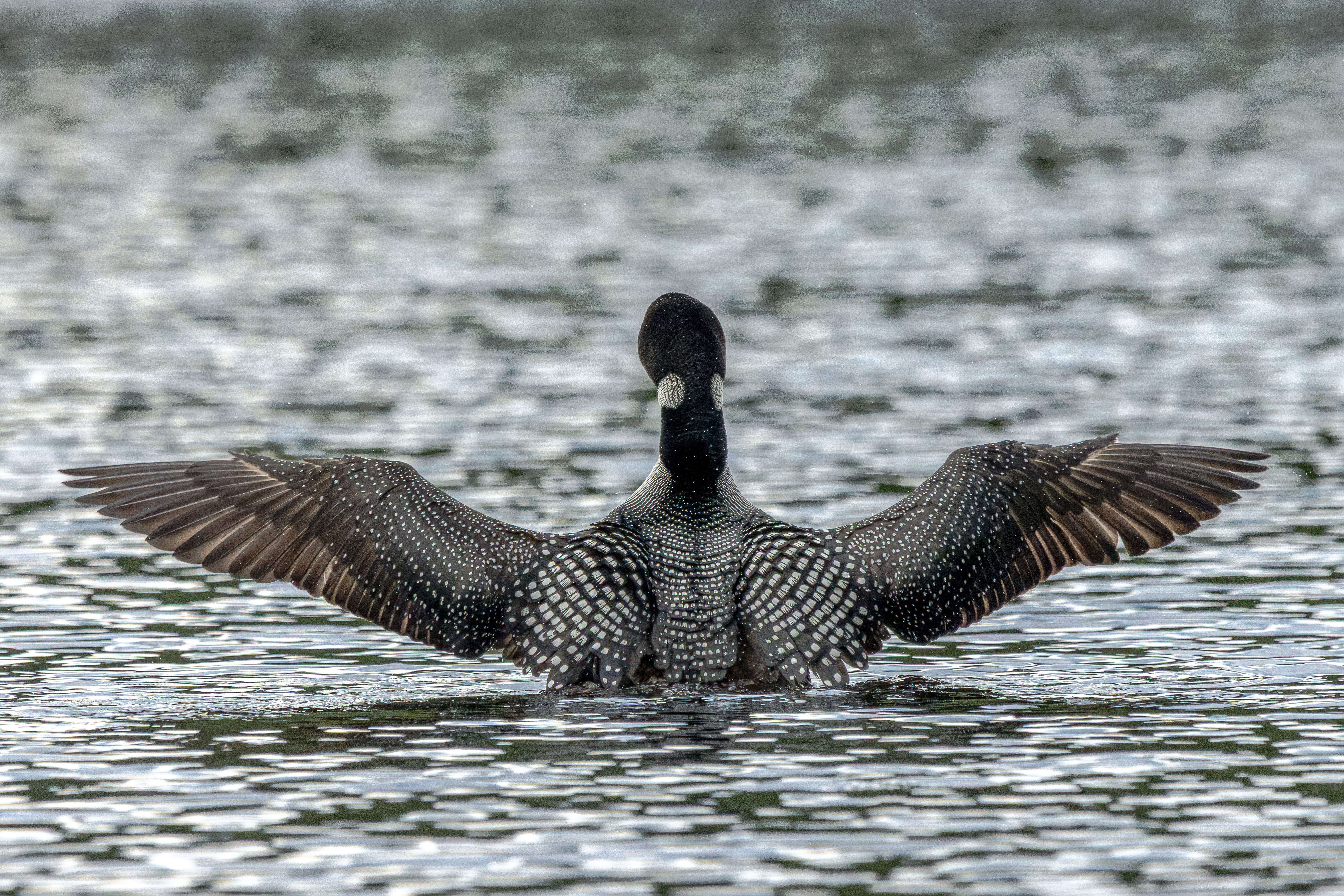


The Common Loon is one of the most iconic waterbirds in North America. Known for its haunting calls, black-and-white breeding plumage, ruby-red eye, and powerful diving ability, the Common Loon is a bird that feels almost tied to wild northern lakes. For many people, the sound of a loon calling across calm water at sunrise or late evening is one of the most unforgettable sounds in nature.
Scientifically known as Gavia immer, the Common Loon belongs to the loon family, Gaviidae. Even though it may look duck-like from a distance, it is not a duck. Loons are built very differently. Their bodies are long and low in the water, their legs are placed far back on their bodies, and their feet act like underwater paddles. This makes them incredible swimmers and divers, but very awkward on land.
The Common Loon is a bird of clear lakes, quiet shorelines, northern forests, coastal waters, and large reservoirs. In summer, it is most closely associated with freshwater lakes across Canada, Alaska, the northern United States, and parts of the Great Lakes region. In winter, many Common Loons move to coastal waters, where their bold breeding colors are replaced by a quieter gray and white plumage.
For birders, photographers, and nature lovers, the Common Loon is a species worth slowing down for. It is not just beautiful. It is also one of the best examples of how a bird can be perfectly adapted to its habitat. Everything about the Common Loon, from its sharp bill to its heavy bones to its long water takeoff, is designed for a life spent almost entirely on water.
How to Identify a Common Loon
The Common Loon is one of the most recognizable birds in North America during the breeding season. In summer, adults are bold, clean, and almost formal-looking. The head and neck are black with a slight green or purple sheen in good light. The throat has a dark band, the neck shows a white striped collar, and the back is covered in a beautiful black-and-white checkerboard pattern. The underparts are bright white, and the eye is deep red.
That red eye is one of the most famous features of the Common Loon. It may help the bird see underwater, though it also gives the bird a fierce and dramatic look. From close range, the eye stands out strongly against the dark head. From far away, the bird’s shape and plumage pattern are usually more important than eye color.
The bill is another major field mark. A Common Loon has a thick, straight, pointed bill that looks strong enough to grab slippery fish. It usually holds the bill level or slightly angled upward. This is different from some similar species, such as Red-throated Loon, which often appears thinner and may hold its bill slightly raised.
Common Loons sit low in the water. Their bodies look long and heavy, and the back often appears flat. Unlike ducks, loons do not bob high on the surface. They can sink lower into the water when alert, leaving only the head and upper back visible. This low profile is one reason they can disappear so quickly when they dive.
In winter, Common Loons look very different. They lose the bold black-and-white breeding pattern and become gray above and white below. The face becomes paler, the neck looks less patterned, and the whole bird appears softer and more muted. Winter Common Loons are usually seen along ocean coasts, bays, estuaries, and large open lakes.
Juvenile Common Loons resemble nonbreeding adults but may show a scaly pattern on the back. Young birds often spend their early years along coastal waters before returning north to breeding areas when mature.
Common Loon Call and Sounds
The Common Loon is famous for its voice. Its calls are some of the most haunting and recognizable sounds in North American birding. A loon call echoing across a quiet lake can sound wild, lonely, and beautiful all at once.
The wail is the long, mournful call most people associate with loons. It is often used when loons are trying to locate each other across a lake. If one loon is separated from its mate or chick, the wail can help them reconnect. This call carries far over still water and is especially powerful in the early morning or after sunset.
The tremolo is a wavering, laughing call often given when a loon is alarmed, excited, or announcing its presence. This is the call that can sound like wild laughter across the lake. Loons may give the tremolo when disturbed by boats, predators, people, or other loons.
The yodel is a territorial call given by males. It is one of the most dramatic Common Loon sounds. Each male has its own version, and the yodel helps defend territory from rivals. If a male changes territory, his yodel may change as well.
The hoot is a softer contact call. Parents may hoot to chicks, and mates may use hoots to stay in touch at close range. Compared with the wail or yodel, the hoot is much quieter and more intimate.
Learning Common Loon calls is one of the best ways to understand the bird’s behavior. A calm loon may be quiet or give soft contact calls. A disturbed loon may tremolo. A territorial male may yodel. A distant bird trying to reconnect with another loon may wail.
Common Loon Habitat
The Common Loon is strongly tied to water. In summer, it is most often found on clear freshwater lakes, especially in northern forests and boreal regions. The best breeding lakes usually have clean water, healthy fish populations, quiet shorelines, and enough open water for takeoff.
Common Loons need space. Because their bodies are heavy and their wings are relatively narrow, they cannot spring straight into the air like many ducks. Instead, they run across the surface of the water while flapping hard. This means they need a long open stretch of water to become airborne. Small ponds may not provide enough room for takeoff.
During the breeding season, Common Loons often choose lakes with islands, coves, floating bog mats, or sheltered shorelines. These areas provide safer nesting locations and protection from wind, waves, predators, and human disturbance. Since loons cannot walk well on land, they usually nest very close to the water.
In winter, many Common Loons move to saltwater habitats. They can be found along ocean coastlines, bays, estuaries, inlets, and nearshore waters. Some also winter on large lakes, reservoirs, and rivers that remain open and ice-free. Along the coast, winter loons are often quieter and more spread out than they are on breeding lakes.
Clear water is especially important because Common Loons hunt by sight. They chase fish underwater, so lakes with poor visibility can make feeding harder. This is one reason loons are often considered indicators of aquatic health. If a lake supports breeding loons, it is often a sign that the water, fish population, and shoreline habitat are still in relatively good condition.
Common Loon Range and Migration
The Common Loon breeds across much of Canada, Alaska, and the northern United States. Its breeding range includes northern forests, boreal lakes, parts of New England, the upper Midwest, the Great Lakes region, and areas of the northwestern United States. In Canada, the species is widespread across many provinces where suitable lakes are available.
In fall, Common Loons leave their breeding lakes before ice locks them in. Many birds migrate to coastal waters for winter. Birds from Alaska and western Canada often move to the Pacific Coast. Birds from the Great Lakes region may move toward the Gulf Coast or Florida. Birds from eastern Canada and the northeastern United States often winter along the Atlantic Coast.
Common Loons are medium-distance migrants. They may migrate over land or along coastlines, depending on where they breed. During migration, they can stop on large lakes, reservoirs, rivers, and coastal waters. In spring, they return north as lakes thaw and breeding territories become available again.
In places like the Great Lakes, Common Loons can be seen during migration as they move between breeding and wintering areas. In some areas, they may appear on inland lakes only briefly before continuing north or south.
One interesting part of Common Loon migration is that juveniles do not always return north right away. Young loons may remain on coastal wintering waters for a couple of years before returning to northern lakes. Even after returning north, they may not breed until they are several years old.
What Do Common Loons Eat?
Common Loons are expert fish hunters. Their diet is made up mostly of fish, including perch, sunfish, minnows, suckers, shad, and other small to medium-sized fish depending on where they live. They usually swallow smaller fish underwater and bring larger prey to the surface.
Loons are visual hunters. They swim along the surface, dip their head below the water to look for prey, and then dive suddenly. Once underwater, they use their powerful feet to chase fish. Their legs are placed far back on the body, which makes them clumsy on land but extremely efficient underwater.
The Common Loon’s body is built for diving. Its bones are more solid than those of many birds, making it less buoyant and easier to submerge. It can release air from its feathers and lungs before diving, helping it sink quickly. Underwater, it moves with strong foot strokes and can turn sharply while chasing fish.
Although fish make up most of the diet, Common Loons also eat crustaceans, aquatic insects, mollusks, leeches, frogs, and sometimes plant material. The exact diet depends on habitat, season, water clarity, and prey availability.
Parents feed chicks small fish and aquatic prey. As chicks grow, they become better at diving and catching food, but they still rely heavily on adults for several weeks. Watching an adult loon bring food to a chick is one of the most memorable behaviors to see on a northern lake.
Common Loon Nesting and Breeding
Common Loons nest on the ground very close to water. Because they can barely walk on land, they need nest sites that allow them to slide or crawl directly from the water onto the nest. This is why loon nests are often found on islands, sheltered shorelines, marshy edges, floating vegetation, or artificial nesting platforms.
The male often chooses the nest site, but both adults help build the nest. The nest is usually made of dead grasses, sedges, reeds, and other plant material from the water’s edge. It may look like a low mound or clump of wet vegetation. Since it is so close to the water, flooding can be a major risk.
A typical Common Loon clutch contains one or two eggs. The eggs are usually brown or olive-brown with darker spots. Both parents incubate, and incubation usually lasts about 26 to 29 days. During this period, the adults must balance keeping the eggs warm with defending the territory and avoiding predators.
After hatching, Common Loon chicks leave the nest quickly. They can swim soon after hatching and may ride on a parent’s back when they are small. This behavior helps keep them warm and may protect them from predators such as large fish, snapping turtles, gulls, eagles, and other threats.
Both parents feed and care for the young. The chicks grow quickly but require a long period of parental care before they can fly. Young loons may take around 12 weeks or more to become capable of flight, depending on conditions.
Common Loons usually raise one brood per year. Because they invest so much time and energy into only one or two chicks, disturbance during nesting season can have a serious impact on breeding success.
Common Loon Behavior
Common Loons spend almost their entire lives on water. They swim, dive, rest, court, feed, and raise young on lakes and coastal waters. They only come onto land to nest, and even then they stay very close to the waterline.
One of the most impressive Common Loon behaviors is diving. A loon can slip under the surface with barely a splash. One moment it is floating calmly, and the next it vanishes. It may resurface far from where it first dove, making it challenging for birders and photographers to track.
Loons are also territorial on breeding lakes. A pair may defend a lake or section of a lake from other loons. Territorial disputes can involve calling, chasing, diving, wing-flapping, and sometimes physical fights. Their sharp bill can be dangerous, and serious fights between loons can occur.
Courtship is usually calm and subtle compared with many other birds. Pairs may swim together, dip their bills, dive in sync, and remain close to each other. Common Loons are often monogamous, and pairs may stay together for multiple years if both birds return to the same territory.
Another classic loon behavior is the back ride. Small chicks climb onto the back of an adult and tuck into the feathers. This helps them rest, stay warm, and avoid some predators. It is also one of the most photographed and beloved Common Loon behaviors.
Common Loon vs Double-crested Cormorant
Common Loons and Double-crested Cormorants can be confused by beginner birders because both are large dark waterbirds that dive for fish. However, they look and behave very differently once you know what to watch for.
A Common Loon has a thicker, straighter, dagger-like bill. It sits low in the water and usually has a smooth, heavy-bodied look. In breeding plumage, it has a black head, white necklace markings, and a checkered back. In winter, it is gray and white with a pale throat and face.
A Double-crested Cormorant has a thinner hooked bill, longer neck, and often a more upright posture. Cormorants frequently perch with wings spread to dry. Common Loons almost never sit on docks, posts, or rocks with wings spread like that.
In flight, cormorants often fly with steady wingbeats and a slightly bent-neck look. Loons fly with the neck stretched straight out and the feet trailing behind. A loon’s body can look heavy and torpedo-shaped in flight.
Behavior is also a clue. Cormorants may gather in large groups and perch together. Common Loons are more often seen alone, in pairs, or in small groups, especially outside of major migration stops.
Common Loon vs Red-throated Loon
The Red-throated Loon is smaller, slimmer, and more delicate-looking than the Common Loon. In breeding plumage, it has a reddish throat patch, gray head, and thinner bill. The Common Loon is larger, heavier, and bolder, with a black head, black-and-white collar, and checkered back.
Bill shape is one of the best differences. A Common Loon has a thick, straight bill. A Red-throated Loon has a thinner bill that often appears slightly upturned. Red-throated Loons also tend to look lighter and more buoyant on the water.
In winter, the differences can be harder. Common Loons remain larger and heavier, with a thicker bill and stronger head shape. Red-throated Loons look more slender, often with a paler face and less bulky structure.
Common Loon vs Pacific Loon
The Pacific Loon is another species that can be confused with Common Loon, especially in winter or during migration. Pacific Loons are smaller and slimmer, with a more rounded head and thinner bill. In breeding plumage, the Pacific Loon has a gray head, dark throat, and bold vertical striping on the neck, while the Common Loon is heavier, darker-headed, and more checkered overall.
In winter, Common Loons usually show a larger body, thicker neck, and stronger bill. Pacific Loons often appear more delicate and may show a sharper contrast between the dark back of the neck and pale throat.
For most birders, size, bill thickness, and overall structure are the safest ways to separate them.
Best Time to See a Common Loon
The best time to see a Common Loon depends on where you live. In northern breeding areas, spring and summer are the best seasons. This is when adults are in their most beautiful breeding plumage, calling across lakes, defending territories, nesting, and raising chicks.
In much of the northern United States and Canada, Common Loons return to breeding lakes soon after ice-out. This can be one of the most exciting times to observe them. They may be vocal, territorial, and active as they reestablish pair bonds and nesting territories.
During fall migration, loons can appear on large lakes, reservoirs, and rivers. They may still show some breeding plumage early in the season, but many transition into gray and white nonbreeding plumage as migration continues.
In winter, coastal areas are often the best places to find Common Loons. Look along bays, inlets, harbors, estuaries, and nearshore ocean waters. They may be quieter in winter, but they can still provide great views as they dive for fish close to shore.
Early morning and late evening are often the most atmospheric times to observe loons on breeding lakes. Calm water, soft light, and distant calls can make the experience unforgettable.
How to Find a Common Loon
To find a Common Loon in summer, search large, clear northern lakes with quiet coves, forested shorelines, islands, and healthy fish populations. Listen before you scan. Often, the first sign of a loon is its call echoing across the water.
Use binoculars to scan the open water. Common Loons are often seen swimming far from shore, but they may also come closer when feeding near drop-offs, coves, or fish-rich shallows. Watch for a long, low bird with a thick pointed bill and a clean black-and-white pattern.
During migration, check large bodies of water. Inland reservoirs, Great Lakes shorelines, wide rivers, and large lakes can all hold migrating loons. They may be alone or in small groups.
In winter, visit coastal areas. Scan nearshore waters, bays, and inlets. Winter loons can blend into gray waves, so look carefully for a low-floating bird that disappears repeatedly beneath the surface.
A spotting scope is helpful, especially on large lakes or coastal waters. However, loons can sometimes come surprisingly close if you stay still, quiet, and respectful.
Common Loon Photography Tips
Photographing a Common Loon is one of the great goals for many bird photographers. The bird has incredible plumage, strong behavior, beautiful habitat, and a powerful connection to northern landscapes.
The best Common Loon photos often come from low angles. A low perspective makes the bird look more intimate and helps separate it from the background. If you are photographing from shore, choose a safe spot near the waterline and wait quietly. If photographing from a kayak or canoe, keep a respectful distance and avoid approaching nests, chicks, or stressed adults.
Morning light is usually best. Calm water can create beautiful reflections, especially when the bird is in breeding plumage. The black head and white checkered back can be difficult to expose correctly, so watch your highlights. It is easy to lose detail in the white chest or collar if the light is harsh.
For behavior shots, look for preening, wing flapping, diving, feeding, calling, courtship, and chick interactions. A loon calling with its head lifted can make a dramatic image. A chick riding on an adult’s back can be a once-in-a-lifetime scene.
Never chase or pressure a loon for a photo. If a loon gives repeated tremolo calls, swims away, flattens itself low in the water, or leaves a nest, you are too close. Ethical photography protects the bird and often leads to better natural images.
Is the Common Loon Rare?
The Common Loon is not rare across its full range, but it can be very local depending on habitat and season. In the right northern lake habitat, it can be regular and expected. In other areas, especially farther south or away from large water, it may only appear during migration or winter.
The Common Loon is considered a species of low conservation concern overall, but that does not mean every local population is secure. In some states and regions, breeding populations are limited, sensitive, or affected by shoreline development, disturbance, pollution, and water quality problems.
For many birders, the Common Loon feels special because it is tied to specific places. You may not see one in every wetland or pond. Instead, it often belongs to big water, clean lakes, northern forests, and quiet shorelines.
Common Loon Conservation
The Common Loon is a symbol of wild lakes, but it faces several serious threats. One of the biggest is lead poisoning from fishing tackle. Loons may swallow small lead sinkers or jigs while picking up grit from the lake bottom or after eating fish that have ingested tackle. Even a small piece of lead can be deadly.
Mercury pollution is another concern. Mercury can build up in aquatic food chains and affect fish-eating birds like loons. High mercury levels can reduce breeding success and harm loon health.
Shoreline development can also reduce nesting success. Loons need quiet, protected nesting areas near the water. Heavy boat traffic, personal watercraft, shoreline clearing, and frequent disturbance can cause adults to leave nests exposed to predators or weather.
Water level changes are another risk. Because loon nests are built so close to the water, sudden flooding can wash away eggs, while falling water can leave nests too far from the shoreline for adults to reach easily.
Fishing line and nets can also harm loons. Entanglement in discarded fishing line can injure or kill birds, and loons may be caught accidentally in some fishing gear.
Climate change may affect Common Loons by changing lake conditions, fish populations, water quality, and the timing of ice-out. In southern parts of the breeding range, warming temperatures and habitat changes may make some lakes less suitable over time.
People can help Common Loons by using lead-free fishing tackle, properly disposing of fishing line, keeping a respectful distance from nesting birds, reducing boat speed near loon families, supporting clean water protections, and protecting natural shorelines.
Interesting Facts About the Common Loon
The Common Loon is built like an underwater hunter. Its legs are positioned far back on the body, giving it powerful swimming ability but making it awkward on land.
Common Loons need a long stretch of open water to take off. They run across the surface while flapping before finally lifting into the air.
A Common Loon’s bones are less hollow than those of many birds, which helps it dive more easily. Loons can swallow small fish underwater, but larger prey is usually brought to the surface.
The Common Loon’s famous calls include the wail, tremolo, yodel, and hoot. The male’s yodel is territorial, and each male has its own signature version. Common Loon chicks can swim soon after hatching and often ride on their parents’ backs.
Young loons may spend their first couple of years along coastal waters before returning north. The Common Loon is the state bird of Minnesota and the provincial bird of Ontario. The Canadian one-dollar coin is nicknamed the “loonie” because it features a Common Loon.
Why the Common Loon Matters
The Common Loon matters because it represents healthy water. A lake with breeding loons is often a lake with clean water, fish, nesting cover, and enough quiet space for wildlife to survive.
This bird is also culturally important. Its voice is strongly connected to northern wilderness, summer lakes, canoe trips, fishing mornings, and quiet evenings on the water. For many people, hearing a Common Loon is not just a birding moment. It is a memory.
Protecting Common Loons means protecting lakes, wetlands, shorelines, fish, forests, and water quality. When we protect loon habitat, we also help countless other species that depend on the same ecosystems.
Final Thoughts on the Common Loon
The Common Loon is one of North America’s most unforgettable birds. Its bold breeding plumage, red eye, haunting call, and powerful underwater hunting ability make it a favorite among birders, photographers, and anyone who loves wild lakes.
Seeing a Common Loon is always special, but hearing one may be even more powerful. A loon call echoing through misty morning air can make an ordinary lake feel ancient and wild.
Whether you find one on a northern breeding lake, a Great Lakes migration stop, or a winter coastline, the Common Loon is a bird worth watching closely. It is beautiful, mysterious, powerful, and deeply connected to clean water.
The next time you are near a quiet lake or coastal bay, scan the water for a low-floating bird with a strong bill and calm, watchful presence. If it suddenly slips beneath the surface and reappears far away, you may have found one of the most iconic birds in North America: the Common Loon.
Leave a Reply