
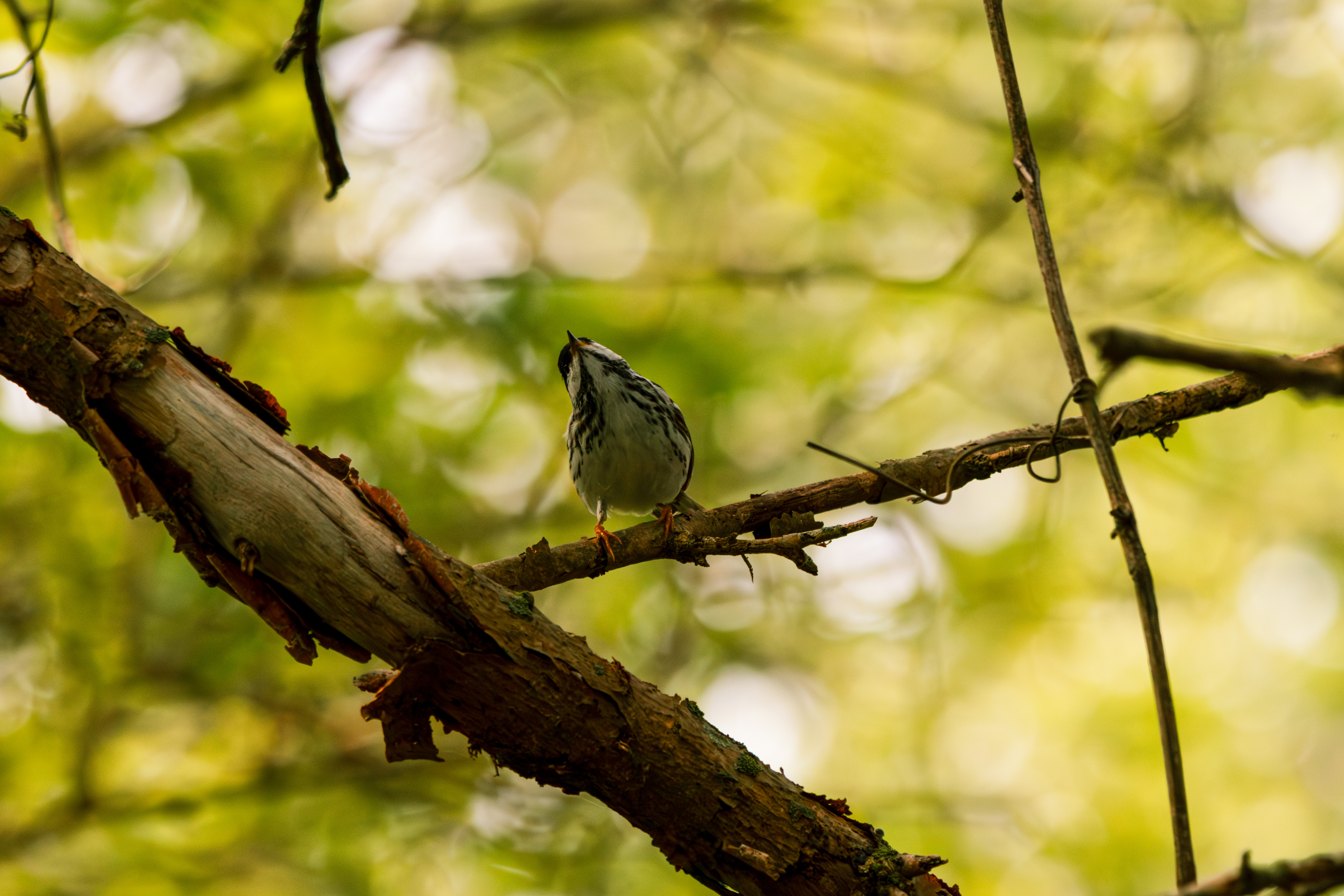


The Blackpoll Warbler is one of the most impressive songbirds in North America. At first glance, it may look like a small black-and-white warbler moving quickly through the trees, but this species has one of the most incredible migration stories of any bird on the continent.
Scientifically known as Setophaga striata, the Blackpoll Warbler is a small wood-warbler that breeds in the northern boreal forest and spends the nonbreeding season in South America. It is famous for its long-distance migration, including a major overwater flight during fall migration. For such a tiny bird, weighing only a fraction of an ounce, the journey it makes each year is almost unbelievable.
During spring and early summer, male Blackpoll Warblers are sharp and striking. They show a black cap, white cheeks, dark streaking, white underparts, two white wing bars, and pale yellow-orange legs. Females and fall birds are much more subtle, often appearing greenish-yellow, streaked, and harder to separate from other confusing fall warblers.
For birders, the Blackpoll Warbler is a species that rewards patience. It can be active, quiet, high in the trees, and easy to overlook. But once you learn the field marks, song, habitat, and timing, this warbler becomes one of the most exciting migration birds to find.
The Blackpoll Warbler is also a bird with a bigger conservation story. It depends on healthy boreal forests, mountain spruce-fir habitat, stopover sites, and wintering forests thousands of miles away. Seeing one is not just a good birding moment. It is a reminder of how connected forests, coastlines, islands, weather, and migration routes are across the Americas.
Blackpoll Warbler Song and Call
The Blackpoll Warbler’s song is one of the highest-pitched songs in the warbler world. Many birders describe it as a thin, rapid series of high “seet” notes. It can sound like “seet-seet-seet-seet-seet,” often rising slightly in pitch and volume. The song is so high and thin that some people have trouble hearing it, especially with age or background noise.
In breeding habitat, the song is one of the best ways to detect a Blackpoll Warbler. The bird may be hidden in dense spruce or fir, but the high, almost insect-like song can give it away. Once you hear the song, scan the upper branches carefully and look for movement near the top or outer edges of the tree.
The call is usually a sharp chip or thin contact note. During migration, Blackpoll Warblers may call while moving through foliage or while traveling with other warblers. Because many warbler calls sound similar, visual confirmation is still important.
Learning the Blackpoll Warbler song is especially useful in boreal or mountain forest habitat. The species can be difficult to see clearly when it stays high in conifers, but the thin song can help you know when one is nearby.
Blackpoll Warbler Habitat
The Blackpoll Warbler is strongly connected to northern forests. Across much of its breeding range, it nests in boreal forest, especially areas with black spruce, white spruce, tamarack, alder, willow, and wet coniferous habitat. These forests often have cool temperatures, dense trees, mossy ground, bog edges, and a mix of wet and dry openings.
In Canada and Alaska, Blackpoll Warblers can breed across vast areas of northern forest. They are especially tied to the boreal zone, one of the most important bird nurseries in North America. This region supports countless migratory birds, including warblers, sparrows, thrushes, flycatchers, hawks, waterfowl, and shorebirds.
In the northeastern United States, Blackpoll Warblers are more limited as breeders. They nest in high-elevation spruce-fir forests, especially in cool mountain habitats. These areas can feel very different from lowland forests. They are often windy, misty, mossy, and dominated by balsam fir and red spruce. Finding a singing Blackpoll Warbler in this habitat feels like finding a true northern mountain specialist.
During migration, Blackpoll Warblers become much more flexible. They can be found in deciduous woods, mixed forests, parks, backyards, coastal thickets, forest edges, gardens, and migration stopover sites. In spring, they often move through leafy forests and wooded wetlands. In fall, they may use fruiting shrubs, coastal vegetation, and areas where insects and berries are available.
Winter habitat is far from the breeding range. Blackpoll Warblers winter in northern South America, where they use forest edges, second-growth forest, and tropical habitats east of the Andes. Their annual cycle connects the boreal forest, eastern North America, Atlantic flyways, Caribbean stopovers, and South American wintering areas.
Blackpoll Warbler Range and Migration
The Blackpoll Warbler has one of the most fascinating migration patterns of any North American songbird. It breeds across northern North America, from Alaska across Canada and into the northeastern United States. In winter, it lives in South America.
In spring, Blackpoll Warblers migrate north through the eastern and central United States, the Caribbean, and parts of Canada. Birders often find them in late spring, especially during May, when warbler migration is at its peak in many regions. They may arrive later than some other warblers because their breeding grounds are farther north.
Fall migration is what makes this species famous. Instead of simply moving straight south from the boreal forest, many Blackpoll Warblers move east toward the Atlantic Coast. From there, they build up fat reserves and then make a long flight over the Atlantic Ocean toward the Caribbean and South America. This overwater migration can last for days.
For a bird this small, the trip is extraordinary. Blackpoll Warblers must time their migration with weather patterns, fuel up heavily before departure, and survive a route with few places to stop once they are over the ocean. This migration is one reason the species is so admired by ornithologists and birders.
In places like Ohio, Pennsylvania, New York, New England, and eastern Canada, Blackpoll Warblers are often seen during migration. In Quebec and other parts of Canada, they can also be found in breeding habitat, especially farther north and in suitable spruce-fir or boreal forest.
Finding Blackpoll Warblers in Quebec Breeding Habitat
Quebec can be an excellent place to find Blackpoll Warblers in the breeding season because large parts of the province include boreal forest and northern conifer habitat. In the right place, the Blackpoll Warbler is not just a migrant passing through. It is a breeding bird using the landscape exactly as it is meant to.
The best places to search are cool coniferous forests, spruce-fir stands, black spruce bogs, tamarack edges, wet boreal woods, and northern forest openings. In mountain areas or higher elevations, look for dense spruce and fir habitat with a cool, damp feel. These are the kinds of places where the thin, high song of a Blackpoll Warbler may come from the upper branches.
In Quebec breeding habitat, listening is often the best first step. The bird can be small, active, and partly hidden by needles and branches. Its song is thin and high, almost like a fine thread of sound coming from the trees. Once you hear it, stay still and watch for movement. The bird may move along outer branches, pause to sing, then disappear deeper into the conifers.
Finding a Blackpoll Warbler in Quebec during the breeding season feels different from finding one during migration. In migration, the bird is usually moving quickly through unfamiliar stopover habitat. In breeding habitat, it is part of a whole northern forest system. The spruce, moss, lichens, bog edges, cool air, and quiet forest openings all make the sighting feel more complete.
For photography, Quebec breeding habitat can create beautiful natural scenes. A Blackpoll Warbler perched on a lichen-covered branch, framed by spruce needles or backlit by early morning forest light, tells a stronger story than a simple close-up. The habitat is part of the bird’s identity.
What Do Blackpoll Warblers Eat?
Blackpoll Warblers eat mostly insects and other small invertebrates. During the breeding season, they feed on caterpillars, beetles, aphids, flies, mosquitoes, wasps, ants, scale insects, spiders, and other tiny prey. These foods are especially important when adults are feeding growing chicks.
Like many warblers, Blackpoll Warblers forage by gleaning. This means they pick insects from leaves, needles, twigs, and branches. They move actively through vegetation, often pausing briefly before making another quick hop or flutter. In conifer forests, they may search among spruce and fir needles. In migration, they may feed in deciduous trees, shrubs, and mixed vegetation.
During fall migration, Blackpoll Warblers need to gain weight before their long overwater flight. They feed heavily before departure and may eat insects as well as fruit or berries. This fuel is critical. A small songbird crossing open ocean must store enough energy to survive hours and days without feeding.
Because this species depends on insects, healthy forests and stopover habitats matter. Native trees, shrubs, and plants support the insect life that warblers need. Even small patches of good habitat can help migrating Blackpoll Warblers rest and refuel.
Blackpoll Warbler Nesting and Breeding
Blackpoll Warblers nest in northern forests, usually in dense conifers or low shrubs. The nest is often placed fairly low in spruce, fir, alder, or other vegetation, depending on the region and available habitat. The female builds a small cup-shaped nest using grasses, twigs, mosses, lichens, rootlets, and other fine plant material.
The breeding season is short in the far north, so timing matters. Blackpoll Warblers must arrive, claim territory, find a mate, nest, raise young, and prepare for migration in a limited window. Northern summers may bring long daylight hours, which can help birds feed and raise young quickly.
A typical clutch contains several eggs, often around four or five. The eggs are usually pale with darker markings. The female incubates the eggs, while the male defends territory and may help with feeding after the young hatch.
Once the chicks hatch, both parents work hard to bring insects to the nest. Caterpillars and other soft-bodied insects are especially valuable food for growing young. The chicks develop quickly and leave the nest before they are fully independent. After fledging, the young continue to be fed by adults while they learn to forage.
Because Blackpoll Warblers breed in remote northern areas, many birders only see them during migration. Seeing one in nesting habitat is a special experience because it shows a part of the bird’s life that is hidden from many people.
Blackpoll Warbler vs Bay-breasted Warbler
The Blackpoll Warbler is often confused with the Bay-breasted Warbler, especially in fall. Both species can be greenish, streaked, and similar in size. They also migrate at similar times and may appear in the same trees.
In fall, Blackpoll Warblers usually show more obvious streaking on the underparts and often have pale yellowish legs. Bay-breasted Warblers tend to look warmer and less heavily streaked below, sometimes with a buffy or peachy wash. The legs on Bay-breasted Warblers are often darker than those of Blackpoll Warblers.
Face pattern can also help. Blackpoll Warblers often look cleaner and more sharply streaked, while Bay-breasted Warblers can look softer and warmer. However, these differences can be subtle, and lighting can change how the bird appears.
In spring, breeding males are much easier. A male Blackpoll Warbler has a black cap and white cheek. A male Bay-breasted Warbler has a rich reddish-bay throat and sides with a darker face and cream-colored patches. The two are much less confusing in full breeding plumage.
Blackpoll Warbler vs Pine Warbler
Fall Blackpoll Warblers can sometimes be mistaken for Pine Warblers because both can show yellowish tones and wing bars. Pine Warblers are usually heavier-looking, with a thicker bill, less sharp streaking, and a more deliberate movement style. They are often found in pine habitat and may move more slowly than many warblers.
Blackpoll Warblers are usually slimmer, more active, and more heavily streaked on the sides and breast. Their bill is thinner, their body looks more delicate, and their pale legs can help separate them. In migration, Blackpoll Warblers may appear in many types of trees, while Pine Warblers are more strongly tied to pines.
The overall impression is important. A Pine Warbler often looks sturdier and plainer. A Blackpoll Warbler looks finer, more streaked, and more classic “confusing fall warbler.”
Blackpoll Warbler vs Cape May Warbler
The Cape May Warbler is another streaky migrant that can cause confusion. Cape May Warblers often show a more curved bill, a stronger facial pattern, and a different body shape. Breeding males have a chestnut cheek patch, yellow throat, and strong streaking. Females and fall birds can be duller but often still show yellowish tones and a hint of the Cape May face pattern.
Blackpoll Warblers usually have a straighter, thinner bill, paler legs, and a different kind of streaking. In fall, Blackpoll often looks greenish-yellow above and whitish below with streaks, while Cape May can look more yellow below and may show a sharper face.
Habitat and feeding behavior can also help. Cape May Warblers often feed in conifers and flowering trees, sometimes using a semi-tubular tongue to take nectar or sap. Blackpoll Warblers are more typical foliage gleaners, picking insects from leaves and branches.
Best Time to See a Blackpoll Warbler
The best time to see a Blackpoll Warbler depends on your location. In much of the eastern United States and southern Canada, spring migration is one of the best times. Late May can be especially productive because Blackpoll Warblers often pass through after some earlier warblers have already moved north.
In fall, Blackpoll Warblers can be seen during late summer and autumn migration. Fall birds are harder to identify because they are much duller than spring males, but they are also exciting because they are preparing for one of the most impressive migrations in the bird world.
In breeding areas, the best time is late spring through summer. In Quebec, northern New England, eastern Canada, and boreal regions, listen for singing males in suitable spruce-fir or boreal forest habitat. Early morning is usually best because birds are more vocal and active.
Weather can make a big difference during migration. After a night of migration, birds may stop in parks, woodlots, coastal areas, and forest edges. A good migrant trap on the right day can produce several warbler species, including Blackpoll Warbler.
How to Find a Blackpoll Warbler
To find a Blackpoll Warbler during migration, start by searching places that attract warblers. Look in mature forests, forest edges, parks, wooded lakeshores, coastal thickets, and areas with native trees and shrubs. Scan slowly through the foliage and listen for sharp chips or high, thin song in spring.
In spring, listen first. The song is high and thin, and it can be easy to miss if there is wind, traffic, or other birds singing. Once you hear a possible Blackpoll Warbler, look high in the trees. Males often sing from upper branches.
In fall, visual identification becomes more important. Search mixed feeding flocks and look carefully at any greenish-yellow, streaked warbler with wing bars. Check the legs, streaking, bill shape, face pattern, and overall structure. Take photos if possible, because fall warbler identification can be difficult in the moment.
To find Blackpoll Warblers in breeding habitat, search northern spruce-fir forests, black spruce bogs, tamarack areas, boreal woods, and high-elevation conifer forests. In places like Quebec, the right habitat can make all the difference. A quiet road through boreal forest, a trail near a spruce bog, or a mountain forest opening can be a good place to listen.
Blackpoll Warbler Photography Tips
Photographing a Blackpoll Warbler can be challenging because the bird is small, active, and often high in the trees. The best approach is patience. Instead of chasing the bird, watch its feeding pattern. Warblers often move through a small area in a repeated path, giving you chances to predict where they may appear next.
For spring males, try to capture the black cap and white cheek clearly. A side profile or slight front angle can show the strongest field marks. Good light helps because the black-and-white pattern can lose detail in harsh shadows.
For fall birds, try to get photos that show the full body, legs, wing bars, face, and streaking. Even if the photo is not perfect, it can help confirm identification later. Fall Blackpoll Warblers can be subtle, and a sharp image of the legs and side streaking can be very useful.
In breeding habitat, include the environment when possible. A Blackpoll Warbler on a spruce branch, with lichens, moss, or boreal forest in the frame, tells the story of the bird better than a tight crop alone. Habitat-based images are especially strong for blog posts because they help readers understand where the bird lives.
Early morning light is often best. Warblers are more active, the light is softer, and insects may be more available. A fast shutter speed helps freeze movement, and patience helps more than anything.
Is the Blackpoll Warbler Rare?
The Blackpoll Warbler is not rare across its full range, but it can be hard to find depending on where and when you are birding. It breeds across huge areas of northern forest, but much of that habitat is remote. During migration, it may pass through quickly, and outside of peak timing it can be missed.
In the right season and habitat, Blackpoll Warblers can be regular. During spring migration, birders in eastern North America may find them in wooded parks, lakefront migration spots, and forested trails. In breeding areas, they may be found by listening for their high song in spruce-fir habitat.
However, this species has experienced serious population declines. Even though it remains widespread, many conservation groups consider it a bird of concern because of steep long-term population losses. Its remote breeding range, long migration, and dependence on multiple habitats across continents make conservation more complicated.
Blackpoll Warbler Conservation
The Blackpoll Warbler is one of the most important warblers to think about from a conservation standpoint. Its life depends on a chain of habitats spread across thousands of miles. If one part of that chain is damaged, the species can suffer.
Breeding habitat is one major concern. Blackpoll Warblers rely on boreal forests, spruce-fir forests, wet coniferous areas, and northern landscapes that are affected by climate change, logging, development, fire patterns, and shifting forest conditions. In mountain breeding areas of the northeastern United States, warming temperatures may reduce suitable high-elevation spruce-fir habitat over time.
Migration is another challenge. Blackpoll Warblers must find safe stopover habitat where they can rest and refuel. Coastal development, loss of forest patches, artificial lights, window collisions, storms, and habitat fragmentation can all make migration more dangerous.
Wintering habitat also matters. These birds spend the nonbreeding season in South America, where forest edges, second-growth habitats, and tropical landscapes support them for much of the year. Conservation must protect the full annual cycle, not just the places where birders see them during spring migration.
People can help Blackpoll Warblers by supporting boreal forest conservation, planting native trees and shrubs, reducing window collisions, turning off unnecessary lights during migration, avoiding pesticides, keeping cats indoors, and protecting stopover habitat. Every safe patch of habitat matters for a bird that travels so far.
Interesting Facts About the Blackpoll Warbler
The Blackpoll Warbler has one of the longest migrations of any North American warbler.
Many Blackpoll Warblers make a long overwater flight during fall migration, traveling across the Atlantic toward the Caribbean and South America.
Before migration, Blackpoll Warblers can build up large fat reserves to fuel their journey.
The breeding male has a bold black cap and white cheek, making it one of the sharper-looking spring warblers.
The fall Blackpoll Warbler is much duller and is one of the classic confusing fall warblers.
The Blackpoll Warbler’s song is so high-pitched that some people have difficulty hearing it.
This species breeds across the boreal forest, one of the most important bird breeding regions in North America.
In the northeastern United States, it also nests in cool high-elevation spruce-fir forests.
Blackpoll Warblers eat mostly insects, but they may also use berries during migration.
Seeing one in breeding habitat is especially meaningful because many birders only encounter this species as a migrant.
Why the Blackpoll Warbler Matters
The Blackpoll Warbler matters because it connects entire continents. A single bird may breed in the northern forest, stop along the Atlantic Coast, cross open ocean, pass through the Caribbean, and winter in South America. Its life is a map of the Americas written in feathers, migration routes, forests, and weather.
It also matters because it shows how strong and fragile migration can be at the same time. The bird itself is tiny, but its journey is enormous. It can survive flights that seem impossible, yet it still depends on healthy forests, safe skies, clean stopover sites, and stable ecosystems.
For birders and photographers, the Blackpoll Warbler is a reminder to pay attention to small birds. A bird that weighs less than a few coins can carry one of the greatest migration stories in nature.
Final Thoughts on the Blackpoll Warbler
The Blackpoll Warbler is one of the most remarkable warblers in North America. Its breeding plumage is crisp and beautiful, its song is thin and unforgettable, and its migration is one of the most impressive journeys made by any songbird.
Whether you find one singing in a Quebec spruce forest, moving through a spring migration hotspot, or hiding in fall foliage before its long flight south, the Blackpoll Warbler is always worth slowing down for.
It may be small, but its story is huge. From boreal forests to Atlantic flyways to South American wintering grounds, the Blackpoll Warbler represents the wonder and difficulty of migration. Seeing one is more than checking off another warbler. It is witnessing one of the great travelers of the bird world.
Leave a Reply