
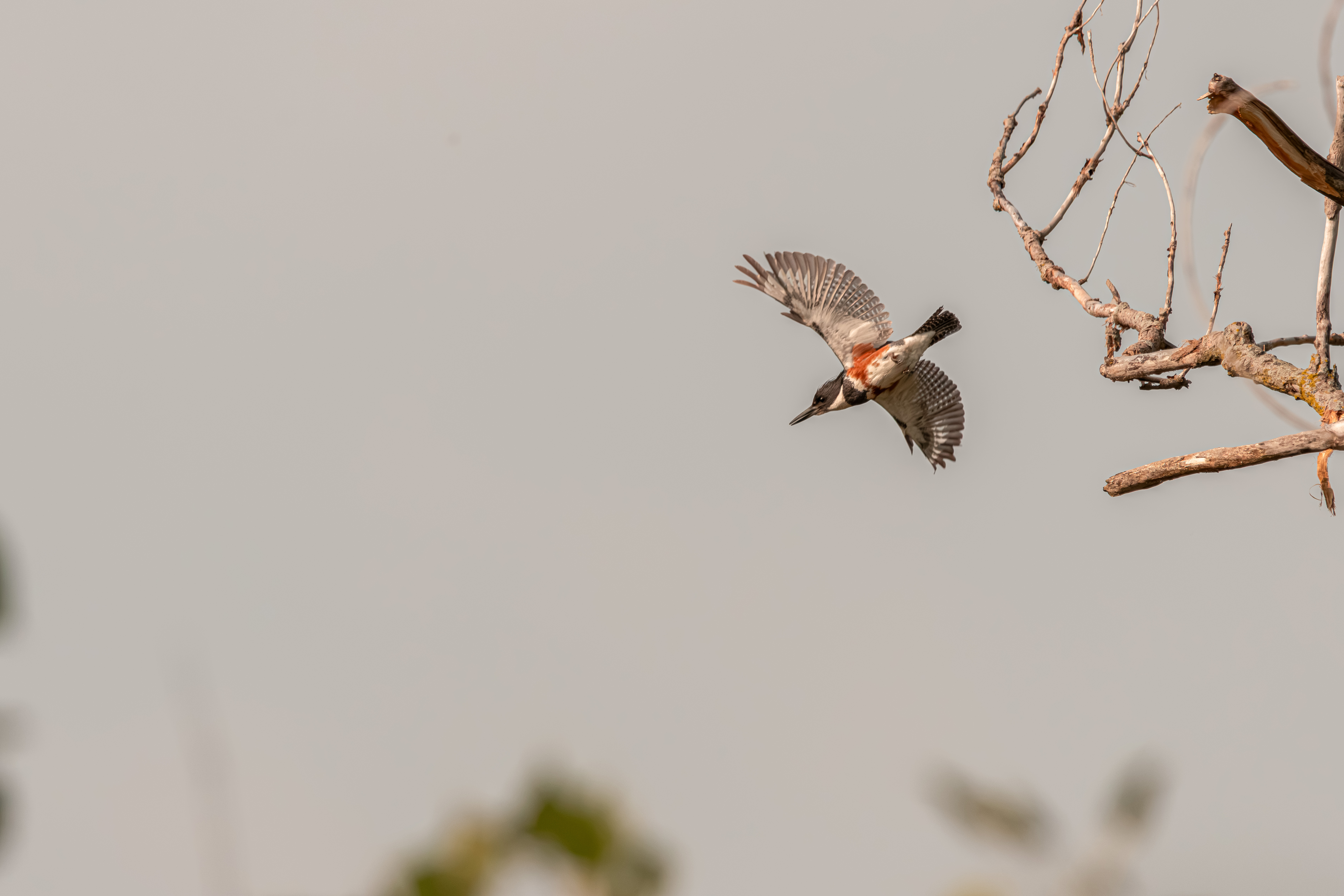


The Belted Kingfisher is one of the most recognizable birds in North America. With its shaggy crest, oversized bill, blue-gray body, loud rattling call, and habit of diving headfirst into water, this bird is hard to miss once you know what to look for.
Scientifically known as Megaceryle alcyon, the Belted Kingfisher belongs to the kingfisher family, Alcedinidae. It is the only kingfisher found across most of the United States and Canada, which makes it the kingfisher species most North American birders are likely to encounter.
This bird is strongly tied to water. It can be found along rivers, creeks, ponds, lakes, reservoirs, marshes, estuaries, and coastlines. If there is open water, small fish, exposed perches, and a nearby bank for nesting, there is a chance a Belted Kingfisher may be nearby.
The Belted Kingfisher is often heard before it is seen. Its loud, dry rattle carries across the water as the bird flies quickly along a shoreline. Many birders first notice this species when it calls, flashes past, and disappears around a bend in a river or across a pond.
For photographers, the Belted Kingfisher can be both exciting and frustrating. It is bold in appearance but often wary around people. It may spot you first, call loudly, and fly farther down the shoreline. Still, when you finally get a close view, it is one of the most rewarding birds to photograph.
How to Identify a Belted Kingfisher
The Belted Kingfisher has a very distinctive shape. It has a large head, thick pointed bill, shaggy crest, short legs, and compact body. Even from a distance, the bird can look top-heavy because of the size of its head and bill.
The main field marks are the blue-gray upperparts, white collar, white underparts, shaggy crest, and bold band across the chest. When perched, the Belted Kingfisher often sits upright or slightly hunched, scanning the water below. When it flies, it usually moves with quick wingbeats along the water’s edge.
Male Belted Kingfishers are blue-gray above with a white collar and a single blue-gray band across the chest. The belly is mostly white. This clean blue-gray and white pattern makes males fairly easy to recognize.
Female Belted Kingfishers are even more colorful. They have the same blue-gray head, back, crest, and chest band, but they also show a rusty-orange band across the belly and rusty color along the sides. This is unusual because in many bird species the male is more colorful, but in Belted Kingfishers the female has the extra color.
A simple way to remember the difference is this: if the bird has rusty orange across the belly, it is a female. If it only has one blue-gray band across the chest, it is a male.
Juvenile Belted Kingfishers can look similar to adults, but they may show uneven rusty markings on the chest or sides. Young males can sometimes look a little like females because of these rusty markings, but the pattern is usually less clean than the adult female’s full rusty belly band.
Belted Kingfisher Call
The Belted Kingfisher is famous for its loud rattling call. The sound is dry, harsh, and mechanical, almost like a rapid clattering noise moving across the water. Once you learn the call, it becomes one of the easiest ways to detect this species.
A kingfisher may call while flying along a river, circling a pond, defending territory, or moving away from a person who got too close. The call often gives away the bird before you ever see it.
During the breeding season, Belted Kingfishers use their calls to defend territories. They may chase other kingfishers away from a stretch of shoreline while rattling loudly. Around nesting areas, they can become especially vocal and alert.
If you are birding near water and hear a loud rattle, immediately scan exposed branches, dead snags, wires, bridge railings, and shoreline perches. There is a good chance a Belted Kingfisher is nearby.
Belted Kingfisher Habitat
The Belted Kingfisher lives around water. It can be found along rivers, creeks, lakes, ponds, reservoirs, wetlands, marshes, estuaries, bays, and coastal shorelines. The most important habitat features are open water, small aquatic prey, and clear hunting perches.
A good Belted Kingfisher location often has overhanging branches, dead trees, exposed roots, docks, bridge rails, or utility wires near the water. The bird uses these perches to watch for fish and other prey near the surface.
Clear or shallow water can make hunting easier, but Belted Kingfishers can use many different types of aquatic habitats. They may hunt along quiet forest streams, busy park ponds, wide reservoirs, muddy rivers, coastal marshes, and neighborhood lakes.
During the breeding season, they also need exposed earthen banks for nesting. Unlike many birds, Belted Kingfishers do not nest in trees. They dig tunnels into dirt banks near water. These banks can be along rivers, streams, lakeshores, sand pits, gravel pits, road cuts, or other steep soil faces.
A lake or pond may have plenty of fish, but if there are no suitable banks nearby, it may not be ideal breeding habitat. This makes natural shorelines and eroding stream banks important for the species.
Belted Kingfisher Range and Migration
The Belted Kingfisher is widespread across North America. It breeds across much of Canada, Alaska, and the United States where suitable water and nesting banks are available.
In many parts of the United States, Belted Kingfishers can be seen throughout the year. In northern areas where lakes, ponds, and rivers freeze, some birds migrate south for the winter. Others remain as long as open water and food are available.
Winter range often depends on access to unfrozen water. A Belted Kingfisher can stay through cold weather if it can still hunt. Moving rivers, large reservoirs, coastal areas, and warm-water discharge zones may hold birds even in winter.
Migrating Belted Kingfishers often follow waterways. They may move along rivers, lakeshores, coastlines, wetlands, and reservoirs. Because they are so closely tied to water, their movements often match the availability of fish and open hunting areas.
In Ohio and the Great Lakes region, Belted Kingfishers are often found near creeks, rivers, park ponds, marshes, reservoirs, and lake edges. They may be easier to find in winter around the few areas that remain open when smaller ponds freeze.
What Do Belted Kingfishers Eat?
The Belted Kingfisher eats mostly fish. Small fish make up much of its diet, but it is not limited to fish alone. It may also eat crayfish, frogs, tadpoles, aquatic insects, mollusks, crustaceans, reptiles, small mammals, young birds, and occasionally berries.
Its hunting style is one of the most exciting parts of its behavior. A Belted Kingfisher usually starts by perching above water. It watches carefully, waiting for movement below the surface. When it spots prey, it launches forward and dives headfirst into the water.
Sometimes the bird hovers before diving. It beats its wings rapidly while holding itself over the water, then drops suddenly when it sees a target. This hovering behavior is one of the best things to watch for when observing Belted Kingfishers.
After catching a fish, the bird usually returns to a perch. It may beat the fish against the branch before swallowing it. Fish are normally swallowed headfirst, which helps the fins and spines go down more smoothly.
Like many fish-eating birds, Belted Kingfishers later cough up pellets made of indigestible parts such as fish bones and scales. These pellets are a normal part of their feeding process.
Belted Kingfisher Nesting
Belted Kingfishers have one of the most interesting nesting habits of any North American bird. Instead of building a nest in a tree or shrub, they dig a burrow into an earthen bank.
The nesting bank is usually steep or vertical and often located near water. Both the male and female help dig the tunnel. They use their bills to loosen the soil and their feet to push the dirt backward. The tunnel often slopes slightly upward from the entrance, which can help keep water from collecting inside.
The burrow can extend several feet into the bank. At the end of the tunnel is a nesting chamber where the eggs are laid. The chamber is usually not lined with soft materials like a typical songbird nest. Over time, fish bones, scales, and other remains may build up inside.
The female usually lays around five to eight white eggs. Both parents help incubate the eggs and both feed the young after they hatch. The chicks remain inside the burrow until they are ready to leave.
Young Belted Kingfishers are fed fish and other aquatic prey. After they leave the nest, they may still depend on the adults for a short time while they learn how to hunt.
Because Belted Kingfishers rely on nesting banks, protecting natural shorelines is important. Too much shoreline development, concrete walls, riprap, and disturbance can reduce the number of places where they can nest.
Belted Kingfisher Behavior
Belted Kingfishers are often solitary. Outside the breeding season, you usually see one bird at a time defending a stretch of water. They can be territorial and may chase other kingfishers away from good feeding areas.
Their territory often follows the shape of the water. Along a stream or river, a kingfisher may patrol a long stretch of shoreline. Around a pond or lake, it may move between favorite perches.
This bird is alert and quick to react. If it notices a person approaching, it often flies away while giving its rattling call. This can make it hard to photograph, especially in open areas where there is little cover.
Even though Belted Kingfishers can seem shy, they often return to the same perches. If you find a branch, wire, or snag that one uses repeatedly, the best strategy is to wait quietly at a respectful distance. Patience is usually better than chasing the bird.
How to Find a Belted Kingfisher
To find a Belted Kingfisher, start near water. Walk slowly along rivers, creeks, ponds, reservoirs, marsh edges, or lake shorelines. Look for exposed perches above the water, especially dead branches, logs, wires, docks, bridge rails, and overhanging limbs.
Listen for the rattle. The call is often the first clue. If you hear it, look in the direction of the sound and scan low over the water. The bird may be flying away along the shoreline or landing on a distant perch.
Early morning can be a good time to look because birds may be actively hunting and human activity is usually lower. Quiet river trails, wildlife refuges, park ponds, and reservoirs can all be good places to search.
If a kingfisher flies away, do not rush after it. Stop and watch where it lands. It may return to its favorite hunting area after a few minutes if it feels safe.
Belted Kingfisher Photography Tips
Photographing a Belted Kingfisher takes patience. These birds are alert and often keep their distance, so the best photos usually come from waiting instead of chasing.
Start by finding a perch the bird uses often. This might be a dead branch over the water, a wire above a creek, or a broken snag near a pond. Once you know where the bird likes to land, position yourself quietly and wait.
A long lens helps because Belted Kingfishers often stay far away. For perched shots, focus on the eye and try to show the crest, bill, and chest band. For flight or diving shots, use a fast shutter speed because they move quickly.
Background matters. A kingfisher against soft water, reeds, distant trees, or a clean shoreline will stand out better than one surrounded by busy branches. Try to frame the bird in a way that shows both the species and its habitat.
Watch the bird’s body language. Before diving, it may lean forward, look down, or shift its feet. If it starts hovering, be ready. The dive can happen fast.
Most importantly, keep distance. If the bird keeps calling, flying farther away, or acting stressed, you are too close. Ethical bird photography leads to better behavior and better images.
Belted Kingfisher vs Similar Birds
The Belted Kingfisher is usually easy to identify, but a few birds can confuse beginners. A Blue Jay can look somewhat similar because it is blue, crested, and loud. However, a Blue Jay has a smaller bill, longer tail, and more typical songbird shape. It is also usually found in woods, parks, and neighborhoods rather than hunting over water.
In southern Texas, the Belted Kingfisher can overlap with Green Kingfisher and Ringed Kingfisher. Green Kingfisher is much smaller and greener. Ringed Kingfisher is much larger, with a massive bill and more rusty color below. Across most of the United States and Canada, the Belted Kingfisher is the expected kingfisher species.
The combination of shaggy crest, large bill, blue-gray plumage, white collar, loud rattle, and water-based hunting behavior makes the Belted Kingfisher stand out from nearly everything else.
Is the Belted Kingfisher Rare?
The Belted Kingfisher is not rare across most of its range, but it can feel difficult to find if you are not looking in the right habitat. It is not a backyard bird in the same way as a cardinal, chickadee, or Blue Jay. It is a bird of water, shorelines, and stream corridors.
In the right habitat, it can be fairly common. Rivers, creeks, reservoirs, marshes, ponds, and lakes can all support Belted Kingfishers. However, during the breeding season, suitable nesting banks are important, so not every body of water will have nesting birds.
In winter, Belted Kingfishers may become more local in northern areas because they need open water. If a pond freezes, the bird must move. If a river stays open, a kingfisher may stay in the area.
Belted Kingfisher Conservation
The Belted Kingfisher is currently considered a species of low conservation concern, but it still depends on healthy waterways and natural shorelines. Water pollution, loss of nesting banks, heavy shoreline development, and disturbance can all affect the species.
Natural riverbanks and lake edges are especially important. When shorelines are hardened with concrete, walls, or heavy rock, kingfishers may lose places to dig nesting burrows. Leaving some natural banks intact can help provide nesting habitat.
Clean water is also important because Belted Kingfishers depend heavily on fish and aquatic prey. Healthy streams, rivers, wetlands, and ponds support the food web that this bird needs.
People can help by protecting streamside habitat, reducing pollution, avoiding disturbance near nesting burrows, properly disposing of fishing line, and supporting wetland and river conservation.
Interesting Facts About the Belted Kingfisher
The female Belted Kingfisher is more colorful than the male because she has an extra rusty-orange belly band.
Belted Kingfishers nest in burrows dug into dirt banks. They often hunt from exposed perches but can also hover before diving. They dive headfirst into water to catch fish. They usually swallow fish headfirst. Adults cough up pellets made of fish bones, scales, and other hard prey parts. Their loud rattling call is often heard before the bird is seen. They are widespread across most of North America. They are one of the most recognizable birds found near water.
Final Thoughts on the Belted Kingfisher
The Belted Kingfisher is one of North America’s most unique water birds. Its shaggy crest, large bill, blue-gray plumage, loud rattling call, and dramatic diving behavior make it unforgettable.
It is also a bird that rewards patience. You may hear it first, watch it fly away, and have to wait quietly before it returns. But when it comes back to a favorite perch or suddenly dives into the water, the moment is always worth it.
Whether you find one along a quiet creek, a large reservoir, a coastal marsh, or a wooded river, the Belted Kingfisher is always worth stopping for. It is wild, alert, loud, and perfectly built for life at the edge of water.


Leave a Reply