
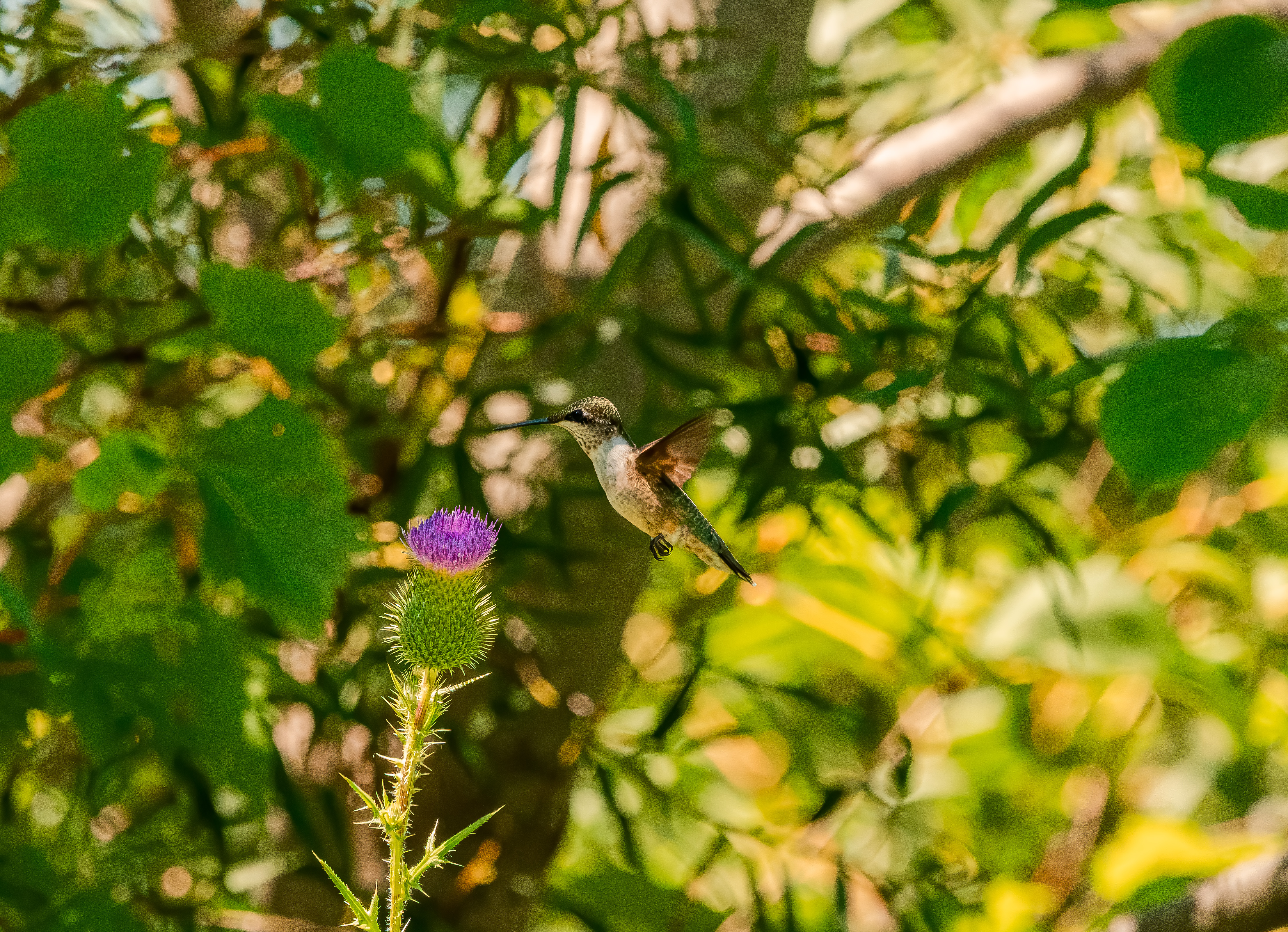


The Ruby-throated Hummingbird (Archilochus colubris) is one of the most recognizable and beloved birds in eastern North America. Tiny, incredibly fast, and capable of hovering perfectly in place, this hummingbird brings a flash of emerald green to gardens, forests, and backyards throughout spring and summer.
Adult males are famous for the brilliant ruby-red throat, or gorget, that gives the species its name. Depending on the angle of the light, this patch can appear glowing red, orange-red, dark crimson, or even completely black. Females lack the ruby throat but share the beautiful green upperparts and rapid, energetic behavior of males.
The Ruby-throated Hummingbird is also an extraordinary migrant. Despite weighing only a few grams, many individuals travel enormous distances between their North American breeding grounds and wintering areas in Mexico and Central America. Some even make a nonstop flight across the Gulf of Mexico.
Whether you’re trying to identify a hummingbird at your feeder, photograph one visiting wildflowers, or understand their incredible migration, the Ruby-throated Hummingbird is one of North America’s most fascinating birds.
Ruby-throated Hummingbird Identification
Ruby-throated Hummingbirds are tiny birds measuring roughly 3 to 3.5 inches long, with a wingspan of approximately 3 to 4 inches. Adults generally weigh only around 2 to 6 grams.
Their small size, needle-like bill, compact body, and extremely rapid wingbeats make them easy to recognize as hummingbirds.
Adult males have metallic emerald-green upperparts, pale grayish-white underparts, dark wings, a forked-looking dark tail, and the unmistakable iridescent red throat.
The male’s throat color is created by microscopic feather structures that reflect light rather than by ordinary red pigment. Because of this, the gorget can change dramatically depending on lighting. From one angle it may glow brilliant ruby red; from another it can look nearly black.
Female Ruby-throated Hummingbirds lack the red throat. Instead, they have a mostly pale throat and underparts with green upperparts. Their tails are more rounded and show white tips on the outer feathers.
Juvenile males initially resemble females but gradually develop scattered red feathers across the throat as they mature.
Male vs Female Ruby-throated Hummingbird
The throat is usually the easiest way to separate adult males and females.
An adult male Ruby-throated Hummingbird has the brilliant ruby-red gorget. In good sunlight, this patch can become one of the brightest colors found on any North American bird.
An adult female Ruby-throated Hummingbird lacks the red throat and instead has a pale throat and chest. Females also tend to have white-tipped outer tail feathers.
Young males can be more difficult because they may only show a few scattered red throat feathers during late summer and fall.
When photographing hummingbirds, don’t immediately assume a dark-throated bird is a female. A male’s ruby gorget can appear completely dark when sunlight hits it at the wrong angle.
Ruby-throated Hummingbird Call and Sounds
Ruby-throated Hummingbirds aren’t famous for elaborate songs, but they are surprisingly vocal.
Their most common sounds include rapid chips, squeaks, and sharp chattering notes. These calls are frequently heard during territorial disputes around flowers and hummingbird feeders.
One of the most noticeable sounds is actually produced by their wings. A nearby hummingbird creates the familiar humming or buzzing sound that gives the entire hummingbird family its name.
Males can become particularly vocal when chasing other hummingbirds away from feeding territories.
Ruby-throated Hummingbird Habitat
Ruby-throated Hummingbirds use a surprisingly wide variety of habitats.
They can be found in deciduous forests, mixed forests, woodland openings, forest edges, meadows, parks, gardens, orchards, stream corridors, wetlands, suburban neighborhoods, and backyards.
Flower-rich areas are particularly attractive because hummingbirds need a dependable supply of nectar and insects.
During migration, they may appear almost anywhere with suitable flowers, insects, shelter, and feeding opportunities. Gardens filled with native flowering plants can become important refueling locations.
Despite their strong association with hummingbird feeders, these are fundamentally forest and forest-edge birds. Feeders simply provide an additional food source.
Ruby-throated Hummingbird Range
The Ruby-throated Hummingbird is the primary breeding hummingbird throughout most of the eastern United States and southern Canada.
Its breeding range extends across much of the eastern half of North America, reaching north into southern Canada and west into portions of the central Great Plains.
For birders throughout Ohio and the Great Lakes region, Ruby-throated Hummingbirds are familiar spring and summer residents. They typically return during spring migration as flowers bloom and insect activity increases.
By late summer, migration begins again as birds start moving south toward their wintering grounds.
Ruby-throated Hummingbirds spend winter primarily in Mexico and Central America, although some individuals winter farther north along the Gulf Coast and southeastern United States.
Ruby-throated Hummingbird Migration
Migration is perhaps the most incredible part of the Ruby-throated Hummingbird’s life.
A bird weighing about as much as a penny can travel thousands of miles every year.
Before migration, hummingbirds enter a period of intense feeding known as hyperphagia. They consume large amounts of food and build substantial fat reserves that provide energy for the journey.
Some Ruby-throated Hummingbirds migrate around the Gulf of Mexico, while others undertake a remarkable nonstop flight directly across the Gulf. This journey can cover roughly 500 miles of open water with nowhere to land.
Spring migration brings the birds north toward breeding territories. Fall migration begins as early as late summer and continues through autumn.
Importantly, leaving hummingbird feeders outside does not prevent hummingbirds from migrating. Migration is controlled primarily by biological and environmental cues such as changing daylight. Keeping feeders available during fall can actually help migrating birds refuel.
What Do Ruby-throated Hummingbirds Eat?
Ruby-throated Hummingbirds are famous for drinking nectar, but nectar is only part of their diet.
They feed from tubular flowers, including trumpet creeper, cardinal flower, bee balm, jewelweed, columbine, salvia, and many other nectar-producing plants.
Nectar provides carbohydrates and quick energy, but hummingbirds also need protein.
They catch tiny insects and spiders from vegetation and sometimes grab flying insects directly from the air. These insects provide protein, fats, minerals, and other nutrients that nectar alone cannot provide.
Hummingbirds may also take insects trapped in spider webs and occasionally consume sap from holes created by woodpeckers and sapsuckers.
Their feeding behavior is incredibly energetic because maintaining hovering flight requires enormous amounts of energy.
How Fast Do Ruby-throated Hummingbird Wings Beat?
The hovering ability of hummingbirds is one of the greatest adaptations in the bird world.
Ruby-throated Hummingbirds can beat their wings roughly 50 times per second during normal flight, with the exact rate varying with activity.
Unlike most birds, hummingbirds rotate their wings through a figure-eight-like motion that produces lift during both portions of the wing stroke. This allows them to hover almost perfectly in one location.
They can also fly forward, backward, sideways, and almost vertically.
During courtship displays, male Ruby-throated Hummingbirds perform dramatic dives around females, reaching much greater speeds than during ordinary hovering flight.
Ruby-throated Hummingbird Nesting
Ruby-throated Hummingbirds build one of the smallest and most impressive nests in North America.
The female handles essentially all nest building and parental care. After mating, the male does not help incubate eggs or raise the young.
The female typically builds her nest on a small horizontal tree branch. She uses soft plant fibers, plant down, and spider silk to construct the tiny cup.
Spider silk is particularly important because it allows the nest to stretch as the chicks grow.
The outside is covered with lichens and other materials that camouflage it against the branch. A completed nest can look like a tiny natural bump on the tree.
Females normally lay two tiny white eggs, each roughly the size of a small bean.
Incubation lasts around two weeks, and the young remain in the nest for roughly another three weeks before fledging.
Ruby-throated Hummingbird Behavior
Ruby-throated Hummingbirds may be tiny, but they can be extremely aggressive. Both males and females defend valuable food sources. Around hummingbird feeders, one bird may claim a feeder and repeatedly chase every other hummingbird that approaches. These aerial chases can involve incredible acceleration, sharp turns, hovering, diving, and loud chattering. Males are also known for their dramatic courtship displays. A male may fly high above a female before repeatedly diving in a wide arc or pendulum-shaped pattern. Despite these aggressive interactions, areas with abundant food can support many hummingbirds, especially during migration.
How to Attract Ruby-throated Hummingbirds
One of the best ways to attract Ruby-throated Hummingbirds is by planting native nectar-producing flowers.
Plants such as cardinal flower, bee balm, trumpet honeysuckle, columbine, jewelweed, and native salvias can provide natural food while also supporting insects hummingbirds need for protein.
Hummingbird feeders can provide another reliable source of energy.
The recommended homemade nectar mixture is simple: one part plain white granulated sugar to four parts water.
Do not add red food coloring, honey, artificial sweeteners, or other ingredients.
Keeping feeders clean is extremely important, especially during hot weather when sugar water can spoil quickly.
Planting native flowers alongside feeders creates a much healthier hummingbird habitat than relying on feeders alone.
Ruby-throated Hummingbird Photography Tips
Photographing Ruby-throated Hummingbirds can be challenging because they are incredibly fast.
A fast shutter speed is helpful for capturing birds in flight, while perched hummingbirds allow slower settings and lower ISO values.
Watch their feeding patterns rather than trying to follow every movement. Individual hummingbirds often return repeatedly to favorite flowers, branches, or feeders.
Position yourself near one of these locations and wait.
Morning and late-afternoon sunlight can make the male’s ruby throat glow dramatically. The angle matters enormously. Moving only slightly can transform the gorget from black to brilliant metallic red.
Flowers also create stronger natural photographs than feeders. Capturing a hummingbird hovering beside cardinal flower, bee balm, or another native plant shows the species naturally interacting with its habitat.
Ruby-throated Hummingbird Conservation
Ruby-throated Hummingbirds remain widespread, but protecting their habitat is important.
Habitat loss, pesticide use, window collisions, invasive plants, declining insect populations, and changes to migration stopover habitat can all affect hummingbirds.
Homeowners can help by planting native flowers, reducing pesticide use, keeping cats indoors, making windows safer for birds, maintaining clean feeders, and preserving native trees and shrubs.
Because these birds migrate such enormous distances, conservation must extend beyond individual backyards. They depend on suitable breeding habitat, migration stopovers, and wintering habitat across several countries.
Interesting Ruby-throated Hummingbird Facts
The Ruby-throated Hummingbird is the most widespread breeding hummingbird in eastern North America. Only males have the brilliant ruby-red throat that gives the species its name. The red gorget is iridescent and can appear black when viewed from the wrong angle. Ruby-throated Hummingbirds can fly backward, something most birds cannot do. Their wings can beat around 50 times every second during normal flight. Some individuals make a nonstop migration of roughly 500 miles across the Gulf of Mexico. Females build their nests using spider silk, allowing the nest to expand as the chicks grow. The female raises the chicks without help from the male. Hummingbirds eat insects as well as nectar. Leaving a feeder outside during fall does not stop hummingbirds from migrating.
Final Thoughts on the Ruby-throated Hummingbird
The Ruby-throated Hummingbird is one of North America’s most extraordinary birds. Its emerald-green feathers, brilliant ruby throat, incredible hovering ability, territorial personality, and long-distance migration make it much more than simply a beautiful backyard visitor.
For many people across eastern North America, the first Ruby-throated Hummingbird of spring marks the true arrival of warmer weather. Months later, watching them feed heavily before disappearing south is one of the first signs that summer is coming to an end.
Whether you’re watching one hover beside a wildflower, defending a backyard feeder, building a tiny nest, or resting during migration, it is difficult not to appreciate just how much life and energy can fit into such a tiny bird.
The next time you hear a faint buzz beside a patch of flowers, look carefully. That emerald flash disappearing through the garden may be one of the smallest, and most remarkable migratory birds in North America.
Leave a Reply