
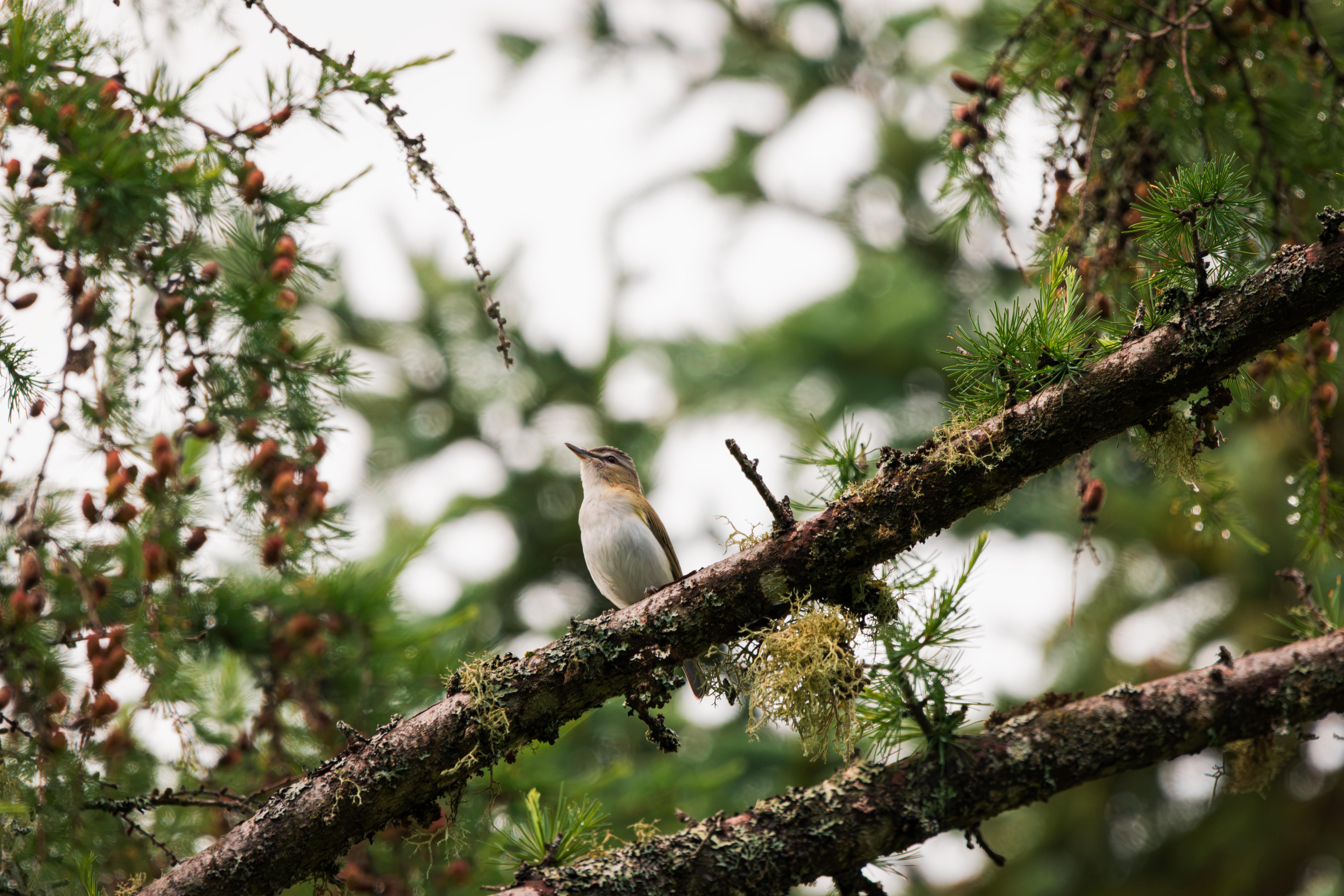


The Red-eyed Vireo (Vireo olivaceus) is one of the most widespread songbirds of North America’s eastern forests, yet it is a bird that many people hear far more often than they see.
Throughout spring and summer, its short and repetitive phrases echo from the forest canopy. Finding the bird responsible can be much more difficult. Red-eyed Vireos spend much of their time searching through leaves high above the forest floor, where their olive-green backs blend remarkably well with the surrounding foliage.
For birders, learning the Red-eyed Vireo’s identification, song, habitat, range, and behavior can transform an otherwise mysterious voice in the treetops into one of the most recognizable birds of the eastern forest.
How to Identify a Red-eyed Vireo
At first glance, the Red-eyed Vireo can appear relatively plain. Look more closely and it has a surprisingly distinctive face.
Adults have an olive-green back, pale grayish-white underparts, gray crown, and a strong white eyebrow bordered by dark lines. The wings lack the prominent wing bars found on several other vireo species. Then there is the feature responsible for its name, the red iris.
The red eye can be striking in good lighting, but it is not always obvious in the field. From a distance or beneath a shaded forest canopy, the eye can appear dark. Juvenile Red-eyed Vireos also have darker eyes. Because of this, birders should not rely on eye color alone. Instead, look for the combination of olive-green upperparts, pale underparts, a gray crown, strong white eyebrow, dark eye line, relatively thick bill, and lack of obvious wing bars. The facial pattern is often the easiest field mark to recognize.
Red-eyed Vireo Habitat
The Red-eyed Vireo habitat is strongly associated with forests. During the breeding season, they favor mature deciduous and mixed woodland, particularly forests with a developed canopy. They can be found among maples, oaks, birches, aspens, and many other deciduous trees. Exact habitat varies depending on geographic location.
Across eastern North America, Red-eyed Vireos inhabit large forests, wooded parks, ravines, river corridors, and other areas containing substantial tree cover. They are particularly associated with forest interiors and mature canopy habitat. This is one reason Red-eyed Vireos can be frustrating birds to photograph. You may hear one singing directly above you for several minutes without ever getting an unobstructed view.
What Do Red-eyed Vireos Eat?
Red-eyed Vireos are primarily insect eaters during spring and summer. Their diet includes caterpillars, beetles, moths, butterflies, wasps, ants, flies, leafhoppers, cicadas, spiders, and many other small invertebrates.
Caterpillars are an especially important food source. Rather than hunting insects with the dramatic aerial flights of a flycatcher, Red-eyed Vireos usually move methodically through vegetation. They carefully inspect leaves, branches, and twigs for prey. Watch one closely and you may see it pause, tilt its head, examine a cluster of leaves, grab an insect, and continue searching.
They may also briefly hover beside leaves to capture prey. Later in the year, berries and other fruits become increasingly important, particularly during migration and on the wintering grounds. Fruit provides valuable energy as these small birds prepare for their long journey south.
Red-eyed Vireo Nesting and Breeding
The Red-eyed Vireo builds one of the classic hanging cup nests found among North American songbirds.
The female typically selects a horizontal fork in a tree branch and suspends the nest between the branches. Instead of simply resting on top of the fork, the nest hangs between the branches like a small basket.The female constructs the nest using grasses, bark strips, plant fibers, spiderwebs, and other fine materials. The outside may be decorated with additional plant material that helps camouflage the nest.
A typical Red-eyed Vireo clutch contains around three to four eggs, although clutch size can vary. The female handles most of the incubation, which lasts roughly 11 to 13 days. After hatching, the young generally remain in the nest for another 10 to 12 days before fledging. The nest can be extremely difficult to notice among dense summer foliage. Birders and photographers should always give active nests plenty of space to avoid disturbing the adults or young.
Red-eyed Vireos and Brown-headed Cowbirds
The Red-eyed Vireo has an interesting relationship with the Brown-headed Cowbird.
Brown-headed Cowbirds are brood parasites. Instead of building nests and raising their own chicks, female cowbirds lay eggs inside the nests of other bird species. Red-eyed Vireos are one of the many species that can become hosts. If a cowbird egg successfully hatches, the adult vireos may feed and care for the much larger cowbird chick. Brood parasitism can become particularly important in fragmented landscapes because forest edges may allow cowbirds easier access to nesting songbirds. Protecting large and connected forest habitats can therefore benefit Red-eyed Vireos and many other forest nesting species.
Red-eyed Vireo Range
The Red-eyed Vireo range covers an enormous portion of the Americas.
During the breeding season, Red-eyed Vireos can be found throughout much of the eastern and northern United States and across large portions of Canada. They are especially widespread throughout the eastern deciduous forest region. For birders in Ohio and the Great Lakes, the Red-eyed Vireo is a familiar spring and summer bird. They arrive during spring migration and quickly become one of the characteristic voices of mature forests. Their presence can continue throughout summer as pairs establish territories, build nests, and raise young. By late summer and early fall, the birds begin preparing for their journey south.
Red-eyed Vireo Migration
Perhaps the most impressive part of the Red-eyed Vireo’s life is its migration. These tiny birds are long-distance migrants.
Red-eyed Vireos breeding throughout Canada and the United States travel south through North America, Mexico, Central America, and the Caribbean before reaching wintering areas primarily in South America. Some individuals travel thousands of miles between their breeding and wintering grounds every year.
During spring, the entire journey happens again in reverse. Birds travel north toward breeding territories throughout the United States and Canada. Considering their small size, the distance these birds travel is extraordinary. A bird weighing less than an ounce can connect forests separated by thousands of miles every year.
Red-eyed Vireos During Fall Migration
Fall provides a very different birding experience. The forests that were filled with singing Red-eyed Vireos during spring and early summer become much quieter.
Birds are no longer advertising breeding territories with the same intensity, meaning identification becomes more dependent on visual field marks and calls. Migrating Red-eyed Vireos may appear alongside mixed groups of warblers, thrushes, flycatchers, and other southbound songbirds. Fruit also becomes increasingly important during this period. Native berry-producing plants can provide valuable energy for birds preparing to continue their migration south.
Red-eyed Vireo vs Philadelphia Vireo
The Philadelphia Vireo is probably the species most likely to cause identification problems. Philadelphia Vireos are generally smaller and usually show more yellow across the throat and underparts. Their facial pattern often appears softer and less sharply defined. Red-eyed Vireos tend to look larger and more elongated, with whiter underparts and a stronger facial pattern. During migration, both species can appear in the same trees, so careful observation is important.
Red-eyed Vireo vs Warbling Vireo
The Warbling Vireo is another possible look-alike. Warbling Vireos have a much softer and less contrasting facial pattern. Their head lacks the Red-eyed Vireo’s strongly defined gray crown and bold white eyebrow. Red-eyed Vireos generally look much more sharply marked around the face. The song is another excellent clue. Learning the different vocalizations of these species can make identification much easier when birds remain hidden among leaves.
How to Find a Red-eyed Vireo
Finding a Red-eyed Vireo usually starts with listening. During spring and summer, visit mature deciduous or mixed forests and listen for repeated short phrases coming from the canopy. Once you hear a bird, stop walking and determine where the sound is coming from.
Instead of looking for an entire bird, watch for small movements among leaves. A Red-eyed Vireo may only expose its head, tail, or body for a second before disappearing behind another cluster of foliage. Early morning is excellent for birding, but Red-eyed Vireos are unusual because they may continue singing well into the middle of the day. This makes them a great species to search for even after the morning bird activity begins to slow down.
Photographing Red-eyed Vireos
Photographing a Red-eyed Vireo can be considerably harder than finding one.
During the breeding season, birds often remain high in the canopy surrounded by leaves and branches. Their habit of constantly moving while foraging adds another challenge.
Listening can help tremendously. Locate a singing male by ear and determine which part of the canopy he is using. Rather than constantly chasing the bird through the forest, find an opening and wait. Red-eyed Vireos may repeatedly return to the same general area while singing and feeding.
Spring migration can provide some of the best photography opportunities because birds sometimes forage lower while traveling through stopover habitat. Early morning light, canopy openings, forest edges, elevated trails, and hillsides can all improve your chances of getting a clean photograph. If you can capture the red iris in direct light, it can completely transform the image.
Red-eyed Vireo Conservation
The Red-eyed Vireo remains widespread across much of North America, but protecting its habitat is still important. Forest fragmentation, habitat loss, window collisions, pesticide use, and changes to migration and wintering habitat can affect migratory songbirds.
Because Red-eyed Vireos travel between continents, threats can occur anywhere along their migration route. Maintaining large areas of mature forest is particularly important on their breeding grounds. People can also help migratory birds by planting native vegetation, reducing pesticide use, keeping cats indoors, protecting forest habitat, and making windows safer for birds.
Interesting Red-eyed Vireo Facts
The Red-eyed Vireo is famous for being one of North America’s most persistent singers. A male can repeat thousands of song phrases during a single day.
Despite the species’ name, the red eye can be surprisingly difficult to see. Lighting and distance often make the iris appear dark.
Young Red-eyed Vireos do not immediately have the brilliant red eyes seen in adults.
Their olive-green upperparts provide excellent camouflage among summer leaves. Red-eyed Vireos eat enormous numbers of insects during the breeding season, including many caterpillars. They switch toward more fruit later in the year as they prepare for migration. Their small hanging nests are suspended from horizontal branch forks. Perhaps most impressive of all, these tiny songbirds migrate between North and South America every year.
Leave a Reply