
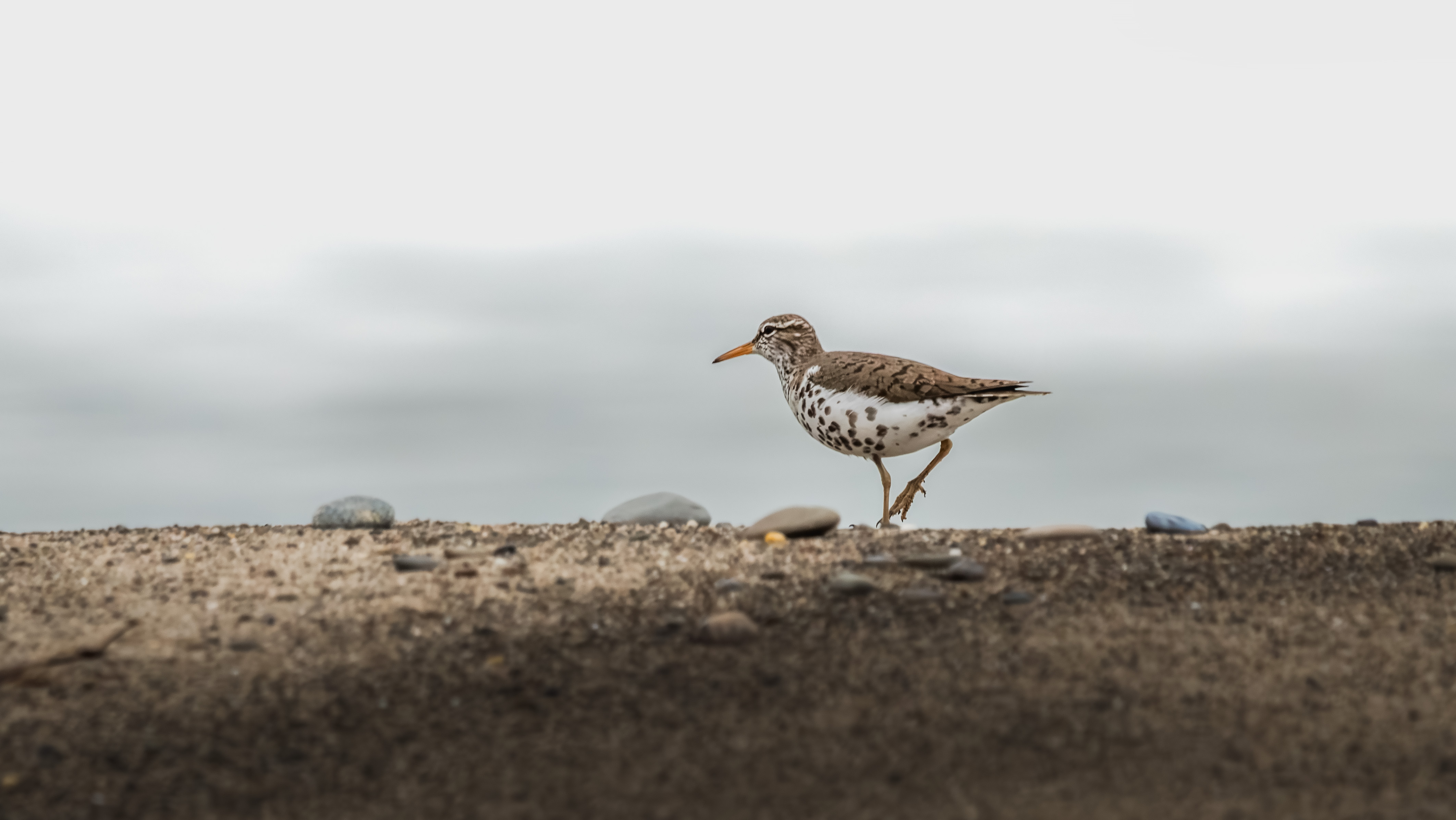


The Spotted Sandpiper (Actitis macularius) is one of the most recognizable shorebirds in North America. Unlike many sandpipers that gather in large flocks along expansive mudflats and ocean beaches, Spotted Sandpipers are often found alone, quietly working their way along the edge of a lake, river, pond, or stream.
Even before you get a clear look at the bird, its behavior can give away its identity. A Spotted Sandpiper seems almost incapable of standing completely still. As it walks, the rear half of its body repeatedly bobs up and down in a distinctive teetering motion.
During breeding season, identification becomes even easier. Adults develop bold black spots across their otherwise white underparts, creating the pattern that gives the Spotted Sandpiper its name.
Behind this familiar shorebird is an unusually fascinating life history that includes long-distance migration, role reversal between males and females, and one of the most unusual breeding systems among North American birds.
Spotted Sandpiper Identification
A breeding adult Spotted Sandpiper is relatively easy to identify.
The bird has dark brown upperparts, bright white underparts covered with bold dark spots, yellowish legs, and an orange bill with a darker tip. A noticeable white eyebrow extends behind the eye. Spotted Sandpipers are medium-sized shorebirds, measuring about 7.1 to 7.9 inches long with a wingspan of approximately 14.6 to 15.8 inches. They are slightly smaller than a Killdeer.
Their posture is also distinctive. They often appear slightly hunched or leaning forward while walking. But the easiest identification clue may have nothing to do with plumage.
Watch the bird’s tail. A Spotted Sandpiper characteristically bobs the rear of its body up and down almost constantly while walking and feeding. This teetering movement is one of the best field marks for identifying the species throughout the year.
Spotted Sandpiper in Fall and Winter
The name “Spotted Sandpiper” becomes slightly confusing outside the breeding season because these birds can lose nearly all of their spots.
In nonbreeding plumage, the breast and belly become mostly white while the upperparts turn grayish brown. Juveniles have a similar appearance. This seasonal transformation can make fall Spotted Sandpipers considerably more difficult to identify.
Fortunately, their behavior remains useful. Look for the familiar constant tail bobbing, slightly crouched posture, relatively short legs, and quick movements along the shoreline.
In flight, another important identification feature becomes visible. Spotted Sandpipers show a thin white stripe across the wing and fly with distinctive shallow, rapid wingbeats interrupted by short glides.
Where Do Spotted Sandpipers Live?
Despite being classified as shorebirds, Spotted Sandpipers are certainly not limited to ocean shorelines. In fact, they are commonly associated with freshwater habitats. Look for them around lakes, ponds, rivers, streams, reservoirs, rocky shorelines, wetlands, and coastal areas. They can occupy surprisingly diverse landscapes as long as suitable shoreline habitat is available.
Spotted Sandpipers occur from sea level into mountainous areas approaching 14,000 feet in elevation. Breeding territories generally combine shoreline, semi-open nesting habitat, and denser vegetation where chicks can find shelter. This flexibility has helped make the Spotted Sandpiper the most widespread breeding sandpiper in North America.
What Do Spotted Sandpipers Eat?
The Spotted Sandpiper diet consists primarily of small invertebrates. Common prey includes midges, mayflies, flies and their larvae, grasshoppers, beetles, worms, snails, and small crustaceans. They may also capture small fish and occasionally feed on dead fish.
Their feeding behavior is much more active than the slow probing associated with some other shorebirds.
A Spotted Sandpiper may walk rapidly along a shoreline before suddenly lunging toward an insect. It can probe mud and sand with its bill, grab insects directly from vegetation, and even capture flying insects from the air.
Watch one for a few minutes and you’ll usually see the same pattern repeated. Walk. Bob. Stop. Grab something. Bob again. Continue down the shoreline. That energetic feeding style is one of the species’ most recognizable behaviors.
Why Do Spotted Sandpipers Bob Their Tails?
One of the first questions people ask after seeing a Spotted Sandpiper is: Why does it constantly bob? The behavior is so distinctive that it can identify the species from surprisingly far away.
Interestingly, the exact purpose of the movement is not completely understood. The bobbing may have a role in communication or help the bird interact with its environment, but there is no single definitive explanation for why Spotted Sandpipers perform the movement so consistently.
What we do know is that the behavior begins early in life and is deeply characteristic of the species. So if you see a small shorebird walking beside a freshwater pond while repeatedly bouncing the back half of its body, a Spotted Sandpiper should immediately come to mind.
Spotted Sandpiper Nesting
The Spotted Sandpiper nest is usually located on the ground near water. Nest sites are generally within about 100 yards of a shoreline, often underneath vegetation that provides shade and concealment.
The nest itself is simple. It begins as a shallow depression in the ground roughly 2 to 3 inches deep and is lined with dead grass and other plant material. A pair may begin several potential nests during courtship before completing the nest eventually used for eggs. A typical clutch contains three to five eggs, with four being especially common.
The eggs are generally pale with darker brown markings that help camouflage them against the surrounding ground. Incubation lasts approximately 19 to 22 days. When the chicks hatch, they are already covered in down with their eyes open. They quickly become capable of walking and feeding. But this is where the Spotted Sandpiper’s breeding story becomes especially unusual.
Female Spotted Sandpipers Take the Lead
In many bird species, males compete for females and females provide much of the parental care. Spotted Sandpipers can completely reverse those roles.
Females are larger, establish and defend territories, perform courtship displays, and may mate with multiple males. Males typically take primary responsibility for incubating eggs and caring for the young. This breeding system is known as polyandry when one female mates with multiple males.
A female may establish a territory and mate with one male. After laying a clutch of eggs that he begins incubating, she may find another male and produce another clutch. Cornell documents an extraordinary case in Minnesota in which a single female laid five clutches for three different males in approximately a month and a half.
Not every Spotted Sandpiper follows this strategy. Some pairs are monogamous, and females may participate in parental care. Still, this unusual role reversal makes the species one of the most fascinating breeding shorebirds in North America.
Spotted Sandpiper Migration
Spotted Sandpipers are migratory across much of their range.
Their breeding distribution extends across an enormous portion of North America. After the breeding season, many individuals travel south toward wintering areas along the southern portions of North America and through Central America, the Caribbean, and South America.
Wintering birds can use beaches, mangroves, rainforest streams, coastlines, and other wet environments. Cornell notes that they may occur at elevations reaching around 6,000 feet on their wintering grounds.
For birders across much of the United States, spring and fall migration provide excellent opportunities to find Spotted Sandpipers along inland waterways. Unlike some shorebirds that require large mudflats or specialized coastal habitat, Spotted Sandpipers can appear along relatively small ponds, creeks, and reservoirs.
Spotted Sandpiper vs. Solitary Sandpiper
The Solitary Sandpiper is one species that can create identification problems, particularly during migration when Spotted Sandpipers lack their namesake spots. Both species frequently occur around freshwater and may be encountered alone. The Solitary Sandpiper usually has a more obvious complete white eyering, darker and more finely spotted upperparts, and a somewhat different body shape. Spotted Sandpipers tend to appear more horizontally oriented and are especially recognizable by their nearly continuous teetering movement. Solitary Sandpipers can also bob or nod, so behavior should not be your only identification feature. Look at the plumage, eyering, body shape, and flight pattern as well.
How to Find a Spotted Sandpiper
One of the best things about searching for a Spotted Sandpiper is that you don’t necessarily need to visit a famous shorebird migration hotspot. Find water. Then check the shoreline. Walk slowly around lakes, ponds, rivers, reservoirs, and streams, paying particular attention to rocky or exposed shorelines. Spotted Sandpipers are frequently seen alone or in pairs rather than packed into large shorebird flocks. Scan exposed rocks, logs, muddy edges, small beaches, and partially submerged branches.
If a bird suddenly takes off, watch its flight. The combination of rapid, shallow wingbeats and short glides low over the water can help confirm the identification even if you never got a perfect view while the bird was standing.
Photographing Spotted Sandpipers
Spotted Sandpipers can be fantastic subjects for bird and wildlife photography because their behavior is relatively predictable. A feeding bird will often follow the contour of the shoreline. Instead of walking directly toward it, watch where the bird is moving and position yourself farther ahead. Remaining still can give the sandpiper an opportunity to approach naturally. Getting low can also dramatically improve shorebird photography.
Photographing from close to the bird’s eye level makes the sandpiper stand out against a softer background instead of photographing downward toward rocks, mud, or water.
Breeding adults offer the classic photograph with heavily spotted white underparts, while fall birds provide an entirely different look.
Try to capture the characteristic bobbing posture, feeding behavior, reflections in calm water, or the moment the bird grabs an insect. Most importantly, give breeding birds and chicks plenty of space. Because nests are placed on the ground and can be extremely difficult to see, avoid walking through vegetation around birds that appear territorial or alarmed.
Spotted Sandpiper Conservation
The Spotted Sandpiper is currently categorized as Least Concern globally, but long-term population data provide reason to pay attention to the species. Audubon’s current migration profile lists a global population estimate of about 660,000 birds.
Cornell reports that North American Breeding Bird Survey data showed an average decline of nearly 1.5 percent per year between 1966 and 2019, amounting to an estimated cumulative decline of approximately 54 percent over that period.
Local habitat degradation can create additional problems. Because Spotted Sandpipers depend so heavily on shorelines and aquatic ecosystems, development, wetland loss, poor water quality, pesticides, herbicides, and polluted runoff can reduce feeding and breeding habitat.
Protecting clean waterways therefore benefits far more than fish and aquatic organisms. It also protects birds that depend on those ecosystems throughout their lives.
Interesting Spotted Sandpiper Facts
The Spotted Sandpiper is the most widespread breeding sandpiper in North America, making it an excellent species for beginning shorebird identification.
Its breeding system is even more unusual than its appearance. Females can be larger and more territorial than males, while males take on much of the incubation and chick-rearing responsibilities. Breeding adults have heavily spotted underparts, but those spots disappear in nonbreeding plumage.
The species can live along everything from small freshwater streams to ocean coastlines and even high-elevation mountain waterways. And perhaps most importantly for identification, a Spotted Sandpiper rarely seems completely still. That constant bobbing motion is often the first clue that tells you exactly what bird you’re looking at.
Why the Spotted Sandpiper Is Worth Watching
The Spotted Sandpiper might not receive the attention of more colorful songbirds or larger waterbirds, but spending a few minutes watching one reveals just how distinctive this species really is.
It walks the shoreline with an almost constant rocking motion, suddenly darts after insects, flies low over the water with quick wingbeats, and transforms from a heavily spotted breeding bird into a surprisingly plain-looking migrant later in the year.
Its breeding behavior makes the species even more remarkable.
In a reversal of the pattern found in many birds, females can compete for territories and multiple mates while males take on much of the responsibility of incubating eggs and caring for young.
So the next time you’re walking beside a lake, river, pond, or stream, pay attention to the shoreline.
If you notice a small brown-and-white shorebird constantly bobbing as it searches for insects, there’s a good chance you’ve found one of North America’s most distinctive shorebirds, the Spotted Sandpiper.
Leave a Reply