
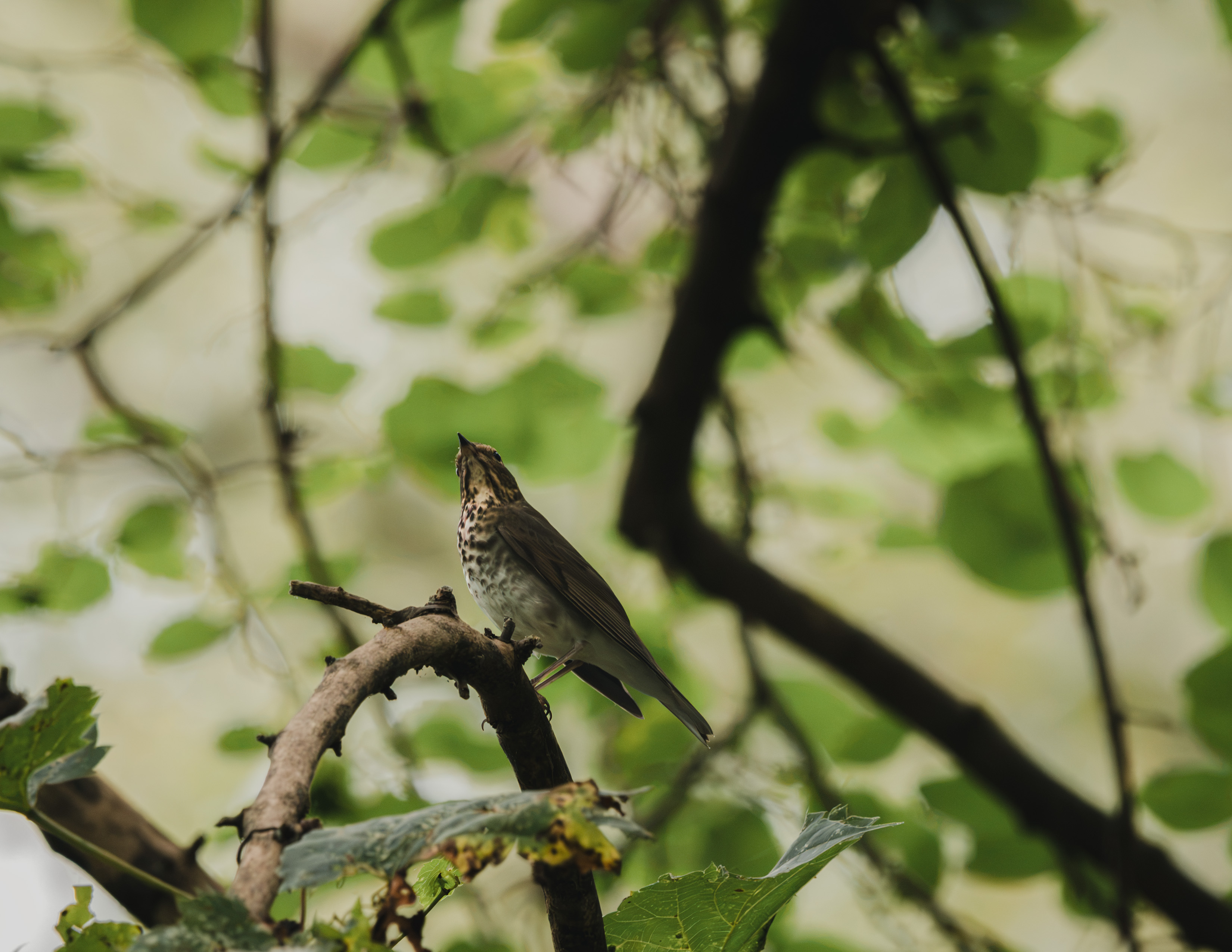


The Gray-cheeked Thrush (Catharus minimus) is one of the more difficult North American thrushes to find and identify. Unlike the familiar American Robin or the more frequently encountered Hermit Thrush, this species spends much of its time hidden within dense vegetation, quietly moving through the understory of forests.
Although its grayish-brown plumage might not immediately stand out, the Gray-cheeked Thrush is an incredible long-distance migrant. Each year, it travels between its northern breeding grounds and wintering habitats in South America, passing through much of eastern North America along the way.
For birders in places like Ohio, spring and fall migration offer the best opportunities to encounter this elusive species.
Gray-cheeked Thrush Identification
Identifying a Gray-cheeked Thrush can be challenging, especially during migration when several similar-looking thrush species are moving through the same forests.
The bird has relatively plain grayish-brown upperparts, a pale underside with dark spotting across the chest, and grayish flanks. Its face is particularly important for identification.
Unlike the Swainson’s Thrush, which has a noticeable buff-colored eyering, the Gray-cheeked Thrush has a much plainer, colder gray face with only a faint or incomplete eyering.
Its wings are relatively long, reflecting its migratory lifestyle, while the tail lacks the noticeable reddish coloration found on a Hermit Thrush.
The sexes look alike, and there is no dramatic seasonal plumage change between spring and fall.
Because lighting can make brown and gray tones appear different, it is important to look at several field marks rather than relying on color alone.
Gray-cheeked Thrush Song and Calls
One of the most interesting characteristics of the Gray-cheeked Thrush is its song. Like other members of the genus Catharus, it produces a series of beautiful, flute-like notes. The song rises through its middle section before typically descending toward the end. This downward ending is especially useful when comparing its song with that of the closely related Bicknell’s Thrush, which generally finishes with rising notes.
During migration, however, birders are more likely to hear its flight call than its full song. Gray-cheeked Thrushes produce thin, high-pitched calls that can sound like wheerrr or vreer. Learning these sounds can help identify birds migrating overhead at night, even when they are impossible to see.
Gray-cheeked Thrush Habitat
The Gray-cheeked Thrush habitat changes considerably throughout the year.
During the breeding season, these birds occupy northern boreal forests and shrubby areas near the transition between forest and tundra. They are particularly associated with spruce forests, alder and willow thickets, and areas with dense understory vegetation. In Alaska and northern Canada, they can nest in relatively open landscapes as long as suitable shrub cover is available. During migration, their habitat preferences become more flexible.
Gray-cheeked Thrushes can be found in deciduous forests, wooded parks, forest edges, and dense thickets. Areas with fruiting shrubs can be especially productive because the birds use these locations to replenish energy during migration. They generally prefer quieter, sheltered areas where they can forage without being exposed.
Gray-cheeked Thrush Migration and Range
The Gray-cheeked Thrush migration is one of the most impressive parts of its natural history.
These birds breed across an enormous northern range extending from eastern Russia through Alaska and northern Canada to Newfoundland and nearby parts of Atlantic Canada. When breeding season ends, they begin a long journey toward their wintering grounds in South America. Much of this migration takes place at night, allowing the birds to travel long distances while spending daylight hours resting and feeding.
Some individuals may make extensive flights over the western Atlantic before reaching northern South America. For birders in Ohio and the Great Lakes region, May is an excellent month to search for Gray-cheeked Thrushes during spring migration. Fall migrants generally begin appearing in September, with some continuing into October. Because these birds often remain hidden, they can be passing through an area without attracting much attention.
What Do Gray-cheeked Thrushes Eat?
The Gray-cheeked Thrush diet consists primarily of insects and other small invertebrates during the breeding season. Beetles, caterpillars, flies, ants, grasshoppers, and spiders all provide important sources of food.
Like many other thrushes, Gray-cheeked Thrushes often forage along the forest floor, hopping through leaf litter and stopping to inspect the ground for movement. They may even vibrate one foot against the ground to disturb insects hidden beneath leaves. During migration and winter, berries and other fruits become increasingly important. These foods help provide the energy necessary for long-distance travel, making fruiting shrubs and trees valuable resources along migration routes.
Gray-cheeked Thrush Nesting and Breeding
Gray-cheeked Thrushes nest in remote northern habitats, which makes their breeding behavior less familiar to most birders. The female constructs a cup-shaped nest using grasses, small twigs, rootlets, moss, and other plant material. Nests are often placed low in shrubs or small trees, although some are built directly on the ground.
A typical clutch contains three to five eggs, which are pale greenish-blue with darker brown markings. Incubation lasts approximately 12 to 13 days. Because these birds breed in areas that are difficult to access, there is still much to learn about their nesting behavior and population trends.
Gray-cheeked Thrush vs. Swainson’s Thrush, Hermit Thrush, and Bicknell’s Thrush
One of the biggest challenges in identifying a Gray-cheeked Thrush is separating it from other members of the Catharus genus.
Gray-cheeked Thrush vs. Swainson’s Thrush: Swainson’s Thrush typically has a more obvious buff-colored eyering and warmer facial tones. Gray-cheeked Thrush appears colder gray around the face and lacks the same strong buff coloration.
Gray-cheeked Thrush vs. Hermit Thrush: Hermit Thrush has a noticeably warmer, reddish-brown tail that contrasts with its back. Gray-cheeked Thrush lacks this strong contrast and usually appears more uniformly grayish-brown.
Gray-cheeked Thrush vs. Veery: Veeries generally have warmer cinnamon-brown upperparts and less contrasting spotting on the chest.
Gray-cheeked Thrush vs. Bicknell’s Thrush: This is the most difficult comparison. The two species are extremely similar in appearance, and many individuals cannot be confidently separated using photographs alone. Vocalizations, breeding range, and geographic context are often the most reliable clues.
Interestingly, Gray-cheeked Thrush and Bicknell’s Thrush were officially recognized as separate species only in 1995.
How to Find a Gray-cheeked Thrush
Finding a Gray-cheeked Thrush requires patience. During migration, one of the best approaches is to search wooded areas with dense shrubs, fallen leaves, and fruiting plants. Rather than looking high in the canopy, pay attention to movement near the ground and within the lower branches.
These birds often remain motionless for long periods before quickly hopping to another concealed location. Early mornings can be particularly productive, especially following nights with favorable migration conditions. If you find one thrush, it is worth checking the surrounding habitat carefully. Other migrating thrushes may be using the same area.
Photographing Gray-cheeked Thrushes
Photographing a Gray-cheeked Thrush can be difficult because the species spends so much time in shaded vegetation. One of the best approaches is to find a location where a bird is already feeding and wait for it to move into a more open position. Trying to follow a thrush through dense shrubs will often cause it to retreat farther into cover.
Soft morning light can help bring out the subtle gray and brown tones in its plumage without creating harsh shadows. For identification photographs, try to capture the face, chest spotting, and tail. These details can be useful when reviewing photographs later. A clear image of the face is particularly valuable when comparing Gray-cheeked and Swainson’s Thrushes.
Gray-cheeked Thrush Conservation
The Gray-cheeked Thrush is currently classified as Least Concern, but its remote breeding range makes population monitoring difficult.
Habitat loss and alteration remain important concerns, particularly in northern forests and South American wintering habitats. Some populations in Atlantic Canada have experienced significant declines. In Newfoundland, introduced red squirrels have contributed to losses by preying on eggs and nestlings. Like many other nocturnal migrants, Gray-cheeked Thrushes are also vulnerable to collisions with buildings and illuminated structures. Protecting forest habitat throughout their annual migration cycle is important for the long-term survival of the species.
Interesting Gray-cheeked Thrush Facts
The Gray-cheeked Thrush is one of the most geographically widespread northern-breeding members of the Catharus genus.
A small breeding population even occurs in eastern Russia, with birds crossing the Bering Sea to join North American migration routes.
Despite being difficult to observe, these birds can migrate overhead in substantial numbers during the night.
The oldest recorded Gray-cheeked Thrush was at least 6 years and 11 months old, based on bird-banding records.
Leave a Reply