
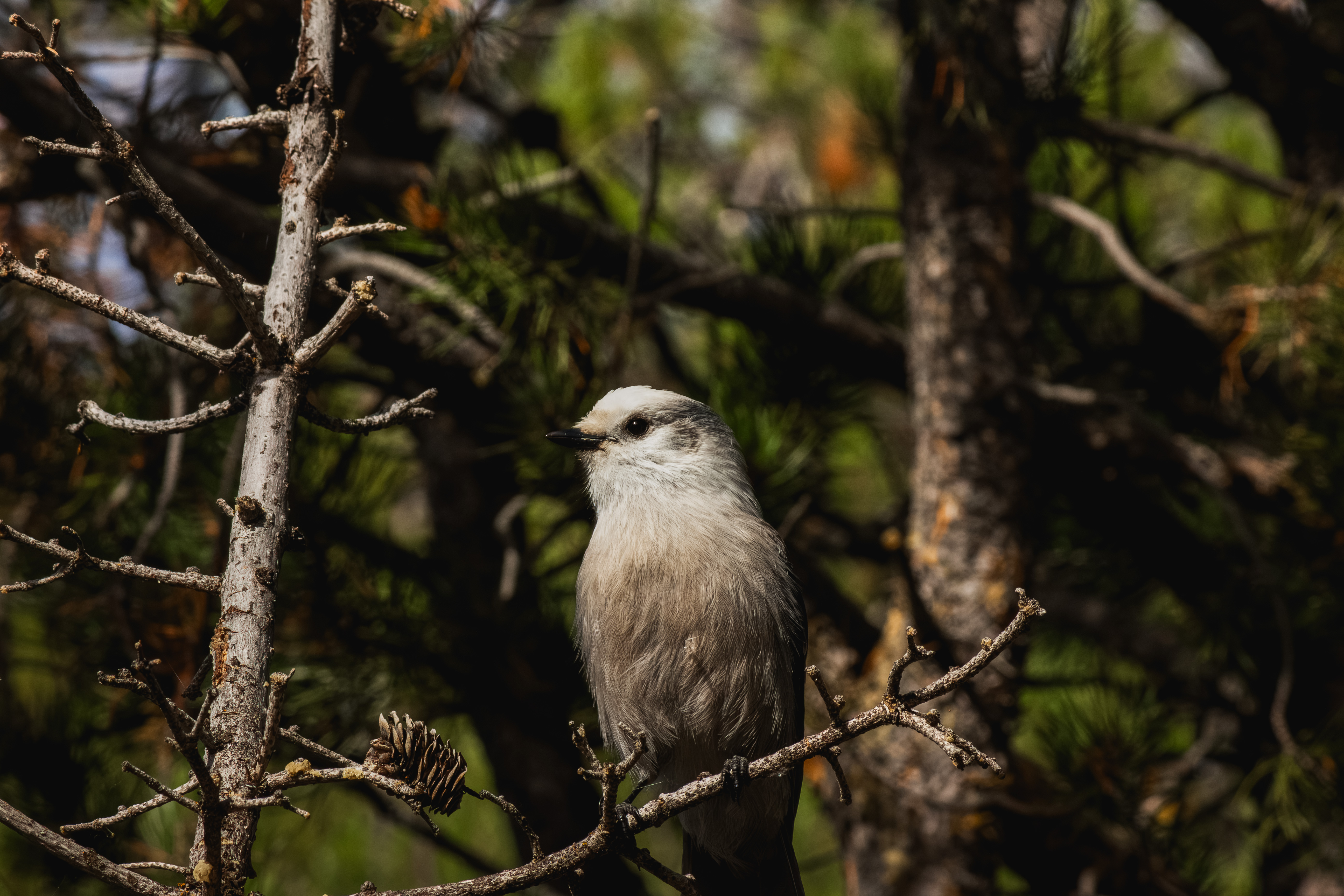


The Canada Jay (Perisoreus canadensis) is one of the most interesting birds living in North America’s northern forests. While many birds migrate south to escape freezing temperatures, Canada Jays remain in their territories throughout the entire year, surviving some of the harshest winter conditions on the continent.
Also known as the Gray Jay or Whiskey Jack, this bird is recognized for its soft gray plumage, rounded head, and surprisingly curious personality. Anyone who has spent time hiking through Canada’s boreal forests or the mountains of the western United States may have encountered one following them through the trees, seemingly interested in everything they are doing.
But there is much more to the Canada Jay than its friendly appearance. These birds store thousands of pieces of food for winter, build nests while snow still covers the ground, and have complex social behaviors that make them one of the most fascinating members of the crow family.
Canada Jay Identification
The Canada Jay identification process is fairly straightforward once you become familiar with its appearance. Adult Canada Jays have a rounded head, short dark bill, long tail, and soft-looking plumage. Their upperparts are generally gray, while their underparts are a lighter gray or whitish color.
One of their most recognizable features is the contrast between their pale face and darker head. Northern birds typically have a white forehead and cheeks, with a dark gray or blackish patch extending across the back of the head. However, their appearance changes slightly depending on where they live. Canada Jays in the Rocky Mountains often have noticeably paler heads, sometimes appearing almost entirely white around the face and crown. Birds along the Pacific Coast can be darker overall.
Male vs. Female Canada Jay
Unlike many other bird species, male and female Canada Jays look almost identical. Both sexes share the same gray plumage, pale facial markings, and rounded body shape. There are no obvious color differences that allow birders to reliably distinguish them in the field.
Juvenile Canada Jay Identification
Young Canada Jays look surprisingly different from adults. Instead of the pale gray and white head pattern, juveniles are usually a much darker charcoal gray, sometimes appearing almost black. They also lack the strong facial contrast seen on adult birds. As they mature, they gradually develop the familiar adult plumage.
Canada Jay Habitat
The Canada Jay habitat is closely connected to the cold forests of northern North America. These birds are most commonly found in boreal and subalpine forests, particularly areas dominated by spruce and fir trees. They also inhabit mixed forests containing aspen, birch, pine, and other northern tree species.
Spruce trees are especially important because their branches and bark provide excellent locations for storing food. Canada Jays are often associated with remote forests, but they can also become familiar sights around hiking trails, campgrounds, and cabins located within their natural range.
Unlike Blue Jays, which are common around suburban neighborhoods and backyard feeders, Canada Jays are much more dependent on northern forest environments.
Canada Jay Range and Migration
The Canada Jay range extends across much of Canada and Alaska, with populations reaching south into parts of the northern United States and the western mountain ranges.
In the United States, Canada Jays can be found in places such as northern Minnesota, northern New England, the Rocky Mountains, and parts of the Pacific Northwest. Their distribution is strongly influenced by the availability of suitable coniferous forests.
They survive by relying on food they have collected and stored during warmer months. Some individuals may move short distances when conditions change, but these movements are very different from the seasonal migrations of warblers, thrushes, and other songbirds. For birders in Ohio, Canada Jays are not regular visitors. Seeing one generally requires traveling farther north or visiting suitable high-elevation forests in the western United States.
What Do Canada Jays Eat?
The Canada Jay diet is incredibly varied.
As members of the corvid family, Canada Jays are opportunistic omnivores, meaning they eat both plant and animal material. Their natural diet includes insects, spiders, berries, fungi, seeds, small mammals, amphibians, bird eggs, and occasionally young birds. They also feed on carrion, taking advantage of animals that have died naturally or remains left behind by larger predators.
Canada Jays usually search for food by moving between branches and carefully examining their surroundings. They may catch insects in flight or forage along the forest floor. Their willingness to investigate almost anything edible has also earned them the nickname Camp Robber. Around campgrounds, these birds sometimes approach hikers looking for unattended food. Although their curiosity makes them entertaining to watch, it is best to let them forage naturally rather than feeding them.
How Canada Jays Store Food for Winter
Perhaps the most remarkable behavior of the Canada Jay is its ability to store food for future use.
Unlike many birds that depend on finding fresh food every day, Canada Jays collect food during the warmer months and hide it throughout their territories. This behavior is called food caching. Canada Jays have unusually large salivary glands that produce sticky saliva. They use this saliva to coat pieces of food, forming small packages that can be attached to tree bark, tucked beneath lichens, or hidden among conifer needles.
They may store insects, berries, pieces of meat, and other foods in thousands of separate locations. What makes this behavior even more impressive is their ability to remember where much of that food has been hidden. When winter arrives and fresh food becomes difficult to find, Canada Jays return to these caches. Their food-storing strategy is one of the main reasons they can survive and even reproduce during the coldest months of the year.
Canada Jay Nesting and Breeding
The Canada Jay nesting season is unlike that of most North American songbirds. While many species wait until spring temperatures rise, Canada Jays often begin breeding in February or March, when snow is still covering the forest floor. This means they may be incubating eggs and raising young during freezing temperatures.
Canada Jays typically form long-term breeding pairs that remain together throughout the year. Both parents help construct the nest, which is usually placed in a coniferous tree close to the trunk. The nest is built from twigs, bark, lichens, and other materials, then lined with soft feathers and fur for insulation. Females generally lay two to five eggs, with incubation lasting approximately 18 to 19 days. The young remain in the nest for around 22 to 24 days before fledging.
Why Do Canada Jays Nest in Winter?
Their unusual breeding schedule is closely connected to their food-caching behavior. By raising young early in the year, Canada Jays can complete much of the breeding season before the warmer months arrive. This allows them to spend more of the summer and fall collecting and storing food for the following winter. It is a remarkable adaptation to life in northern forests.
Canada Jay Calls and Sounds
Although Canada Jays belong to the same family as Blue Jays and crows, they are generally much quieter.
The Canada Jay call includes soft whistles, chuckling sounds, hoots, and occasional harsh scolding notes.
Some vocalizations sound like a drawn-out whee-ah, while others consist of short chattering calls.
These birds communicate with one another while moving through the forest and may become much louder when responding to predators or other threats. Unlike the loud calls of a Blue Jay, Canada Jay vocalizations can be surprisingly subtle. Learning their calls can be useful when searching dense coniferous forests where the birds may be difficult to see.
Canada Jay vs. Blue Jay
The Canada Jay vs. Blue Jay comparison is useful because both birds belong to the same family but have very different appearances and behaviors. Blue Jays have bright blue upperparts, black and white markings, and a noticeable crest on their heads. Canada Jays lack the crest entirely and have mostly gray and white plumage.
Their habitats are also different.
Blue Jays are widespread throughout eastern North America and commonly visit neighborhoods, parks, and backyard feeders. Canada Jays are much more closely associated with northern boreal forests and high-elevation mountain habitats. Both species are intelligent and store food, but the Canada Jay’s dependence on cached food during winter is particularly important to its survival.
Why Is the Canada Jay Also Called the Gray Jay or Whiskey Jack?
For many years, the Canada Jay was officially known as the Gray Jay.
In 2018, the American Ornithological Society restored the name Canada Jay, which had been used historically for the species.
Another familiar name is Whiskey Jack, sometimes written as Whiskyjack.
This name has Indigenous origins and is derived from names such as Wisakedjak in Cree traditions. The bird has an important place in the stories and cultural traditions of several Indigenous peoples.
The nickname Camp Robber comes from its tendency to investigate and occasionally take food around campsites.
All three common names refer to the same species, Perisoreus canadensis.
Leave a Reply